Autumn Maples with Poem Slips
Tosa Mitsuoki · c. 1675
Explore the painting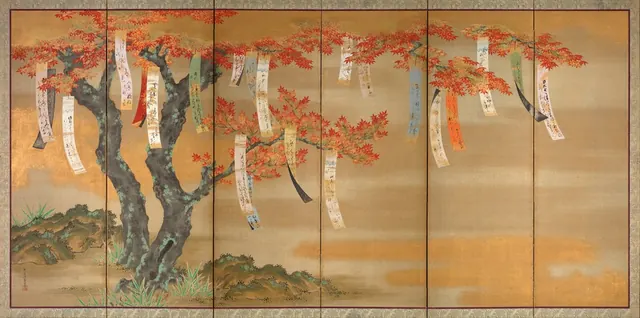
Narrow slips of poetry hang from the maple branches. They remain after a courtly gathering whose participants admired autumn foliage and recalled older verse. Tosa Mitsuoki shows the garden without its visitors. Written lines and strips of paper tied to the tree preserve the gathering's traces, turning landscape into a record of a literary custom.
The trunk spans several panels and branches close to the ground. Dark bark and green patches make the tree tangible, while no detailed vista opens behind it. Mitsuoki concentrates on the maple as a gathering place, allowing one large tree to fill part of a palace interior.
Red leaves still cluster on slender branches. Autumn supplies the subject of the poems. Seasonal imagery was central to court poetry, and educated participants recognised references to earlier writing. The screen's inscriptions include appropriate verses from twelfth- and thirteenth-century anthologies. A contemporary gathering continued an exchange with centuries-old literature.
The long paper slips are called tanzaku. Poems were written in elegant hands on paper that could itself carry decorative patterns. Tied to a branch, calligraphy became part of the garden. Here painting reproduces both the tree and the writing, allowing the viewer to look at the landscape and read it at the same time.
Some slips bend as if displaced by a light breeze. Their turns are especially noticeable against the folding screen's regular vertical divisions. Mitsuoki imagines the interval after the festivities, when the visitors have left but traces remain. The museum connects this choice with the transience of beauty, a recurrent concern of seasonal court poetry.
Paler slips hang beside brightly coloured papers. Differences of colour and pattern distinguish them even before their characters can be read. Their rhythm extends across the canopy, carrying the eye from the heavy trunk towards the outer branches and gradually revealing the screen.
Grass and small patches of earth appear only around the roots. The tree remains grounded, while its wider surroundings are left undefined. Gold reflected light from the room and integrated the painted garden into its furnishings. Six hinged panels could be set at angles, changing the apparent intervals between branches and inscriptions.
Open gold on the right balances the densely worked left side. A companion screen depicts a flowering cherry tree in spring. Together they compared two seasons and two occasions for poetic gatherings. The screens were commissioned by, or presented to, Empress Tofukumon-in, daughter of a Tokugawa shogun and wife of Emperor Go-Mizunoo.
During the seventeenth century the shogunate increased its control over the imperial court. The imperial couple nevertheless encouraged a revival of older aristocratic culture. Mitsuoki, a leading court painter, participated in that return to the past. Autumn foliage and medieval poetry show how the court sustained cultural continuity despite its restricted political authority. The return to old poetry can be understood both as attachment to the past and as an assertion of the court’s particular authority. These readings are compatible. The object itself supports discussion: costly court furnishings addressing viewers able to recognise literary quotations.
- Medium
- Six-panel screen (one of pair); Ink, colors, gold leaf, and gold powder on silk
- Collection
- Art Institute of Chicago
- Dimensions
- 144 × 286 cm
- Accession number
- 1977.157
Sources
Image provided under CC0. Image licence
Adapted and translated from Art Institute of Chicago materials. · Text licence