Milarepa on Mount Kailash
Unidentified Tibetan painters · c. 1500
Explore the painting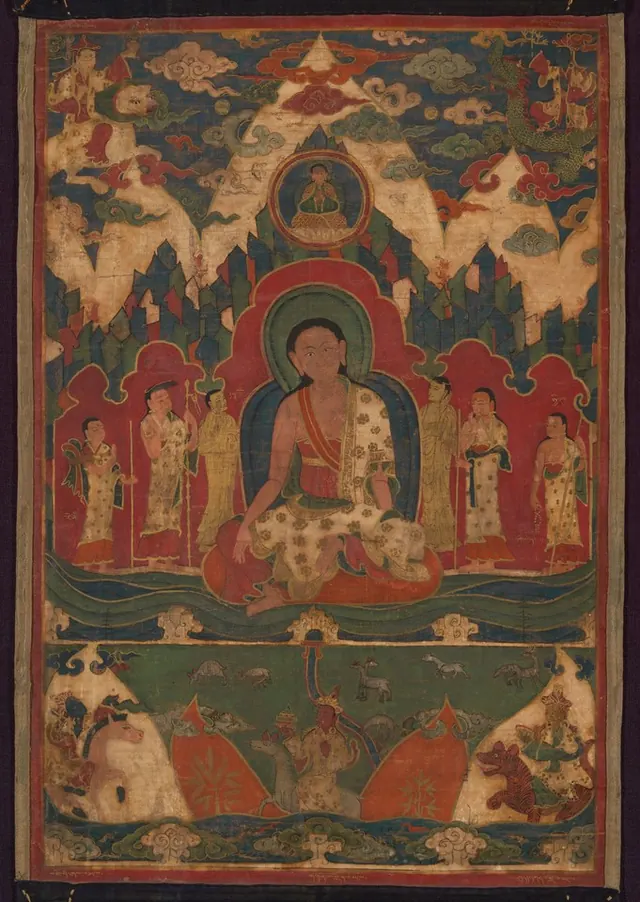
Milarepa lived in Tibet around the eleventh and twelfth centuries and became renowned as a Buddhist teacher, poet and singer. This thangka was made around 1500, several centuries after his death. It brings together the revered master, disciples and a sacred mountain landscape. The cloth image could be rolled for transport. Its purpose belongs to devotional practice and the memory of transmitted teaching.
Milarepa sits at the centre in a mountain cave. Much larger than his companions, he faces the viewer within a halo. The difference of scale establishes the image's principal figure. Bodily details remain distinct, including the inclination of his head, exposed shoulder, hands and crossed legs.
Floral patterns cover his pale clothing. Clear folds separate it from the red and green surroundings. Such clarity helps organise a complex thangka containing numerous figures within a restricted space. A single natural light source does not govern the whole scene. Important figures remain legible wherever they appear among the mountains.
Wavy blue and green bands run beneath the central group, representing Lake Manasarovar beside Mount Kailash. Water separates Milarepa and his disciples from the lower scenes. Actual geography enters a religious world in which a place matters especially through its association with a revered teacher and a sacred mountain.
White peaks surround the figures, with sharp multicoloured foothills below. Kailash is sacred to Buddhists and Hindus alike. These mountains cannot be read as a view from one fixed position. Their shapes organise the space around the teachers, bringing different scenes and beings into one vertical composition.
The Five Sisters of Long Life occupy the perimeter. These mountain goddesses became protectors of Buddhism devoted to Milarepa. Each inhabits a separate area among rocks and clouds. Their presence extends the saint's story into a world where natural powers participate in protecting religious teaching.
One goddess occupies the lower centre among animals and mountains. The small figures demand close inspection, while Milarepa is immediately recognisable. Alternating scale creates different levels of reading. The overall view identifies the revered teacher; closer study gradually reveals his companions and connections.
Marpa, Milarepa's teacher, appears above him within a circular frame. Their vertical arrangement makes the succession of teaching visible. After encountering the principal figure, the viewer discovers the master from whom he learned. The disciples beside Milarepa belong to the same transmission of knowledge.
A long Tibetan inscription on the reverse recounts Milarepa's life. It helps museum researchers identify this work as one of his earliest surviving representations. The reverse is not shown here, but its text matters to the attribution. Image, biographical memory and a lineage of teachers together give the painting a purpose extending beyond the representation of a beautiful mountain landscape. A museum presents the thangka open, stationary and available to any viewer. This differs from encountering a portable object in religious practice. Admiring the mountains as pattern offers one experience; tracing relations among teachers, disciples and protectors offers another. The former cannot exhaust the latter.
- Medium
- Pigment and gold on cotton
- Collection
- Art Institute of Chicago
- Dimensions
- 45.5 × 30 cm
- Accession number
- 1995.277
Sources
Image provided under CC0. Image licence
Adapted and translated from Art Institute of Chicago materials. · Text licence