The Interior of the Palm House on the Pfaueninsel Near Potsdam
Carl Blechen · 1834
Explore the painting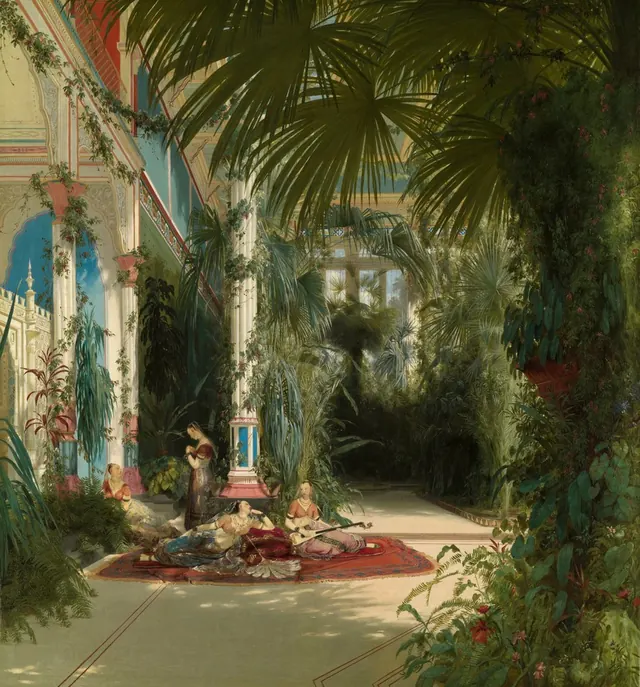
A palm house designed by Karl Friedrich Schinkel was built on the Pfaueninsel near Potsdam to display the Prussian royal collection of tropical plants. Blechen painted its interior in 1834. Huge palms grow among decorated columns, with richly dressed women below. The actual building is combined with an imagined scene that the museum relates to European colonial fantasies about non-European women.
Palm fronds overlap the upper interior. Their curves resemble arches and extend the architectural pattern, yet they vary in angle and density. Blechen invites comparison between living plants and the deliberately constructed space that houses and displays them.
Pale columns with coloured ornaments rise on the left, entwined with plants. The greenhouse presents a royal collection as a spectacle maintained under specially created conditions. Tropical vegetation belongs here to a European palace establishment. Natural diversity meets a wealthy owner's ability to collect and exhibit rarities.
Women sit and recline on a red carpet. Small beside the plants, their bright clothes connect them with the building's ornament. The museum does not treat this as a documentary record of the greenhouse's inhabitants. They belong to an imagined scene of leisure associated by the European painter with exotic luxury.
A standing woman marks the edge of the illuminated area. Her figure helps us measure the height of the room and palms. That role also deserves scrutiny. If a person primarily supplies scale and decoration within someone else's collection, how far does the painting allow her an individual identity? The question arises from her smallness within the immense ornamental setting.
Light near a column connects a woman's clothing, foliage and painted surfaces. Blechen closely observes colours changing under different illumination. Yet accuracy of light does not authenticate the entire event. A painter can render an existing interior convincingly while filling it with invented participants.
A gap between trunks opens a deeper part of the building. Overlapping layers of greenery become progressively less distinct, inviting an imaginary walk inside. Blechen developed his handling of light and atmosphere following an Italian journey around 1828–29, an important experience in the evolution of his technique.
Dense dark vegetation on the right almost hides the room's boundaries, making the lit floor appear brighter. The contrast suggests a humid enclosed garden. Blechen used interiors and landscapes as settings for enigmatic figures; the museum connects this tendency with his early encounters with Romantic painting and theatre.
Two connected readings emerge. The painting carefully studies light within a real greenhouse, while also revealing a culture that could turn plants and people into objects of imagined possession. The building's history alone cannot explain the scene. The women on the carpet raise questions about who constructs this image of another world, and whose individual history it allows to appear.
- Medium
- Oil on canvas
- Collection
- Art Institute of Chicago
- Dimensions
- 135 × 126 cm
- Accession number
- 1996.388
Sources
Image provided under CC0. Image licence
Adapted and translated from Art Institute of Chicago materials. · Text licence