The Gathering at the Orchid Pavilion (front); Geese among Reeds (back)
Noguchi Shohin · 1900
Explore the painting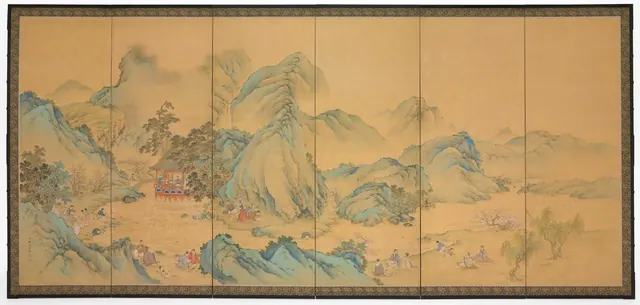
In 1900 Noguchi Shohin depicted the celebrated gathering at the Orchid Pavilion. Wang Xizhi and scholarly friends met in Zhejiang, China, in spring 353 for poetry, music and wine. This screen belongs to a pair bringing an old literary model into a Japanese interior. More than fifteen centuries of cultural memory separate event and image.
A large blue-green mountain occupies the centre. Small figures form distinct groups at its foot. Landscape accommodates many guests without crowding them indoors. Scholarly exchange unfolds among natural forms that could themselves inspire poetry.
A red pavilion stands among trees on the left. Bright architecture provides a recognisable centre, while most guests remain outside. People sit individually and in groups along the banks. Shared activity unites them while preserving separate positions within an extensive setting.
Rocky ledges descend towards a stream. According to the festival account, servants filled cups with rice wine, placed them on lotus leaves and floated them downstream for guests to retrieve. Winding water organises the gathering itself, connecting distant groups.
Scholars turn towards companions or water. Poses and small objects make the ancient tradition visible as people’s activity. Attendants share the scene. Poetry and informality depend on agreed practices and the labour maintaining them.
Blue-green rocks recur in the foreground, connecting nearby passages with the central mountain. Gold between them unites land, water and air. An expensive surface makes remembrance part of festive decoration while preserving precise little figures.
A pale tree crown on the right opens a view towards the farther bank. This freer edge balances the dense centre. Detailed groups alternate with open passages, allowing separate encounters to be examined. Screen folds change their actual depth within a room.
A remote peak appears at the upper left beyond a pale interval, extending the setting beyond its guests. Shohin studied painting from childhood within the scholarly tradition. She later won recognition at Chicago’s 1893 World’s Columbian Exposition and became an Imperial Household artist. Chinese subject matter belonged to an acclaimed professional practice.
On the reverse, Shohin painted geese and reeds more freely against silver. Turning the screens exchanged gold for silver, spring for autumn and a populated story for nature. Her daughter displayed the pair at a memorial exhibition in 1929. An ancient male scholarly gathering thus became part of remembrance of a distinguished woman painter, adding another layer to an image devoted to preserving a cultural encounter.
- Medium
- Pair of six-panel screens; ink, colors, and gold on silk (front); ink and silver on paper (back)
- Collection
- Art Institute of Chicago
- Dimensions
- Each, 182.5 × 391 cm
- Accession number
- 1996.680.1-2
Sources
Image provided under CC0. The front of one screen from a pair is shown. Image licence
Adapted and translated from Art Institute of Chicago materials. · Text licence