Mountain Brook
Albert Bierstadt · 1863
Explore the painting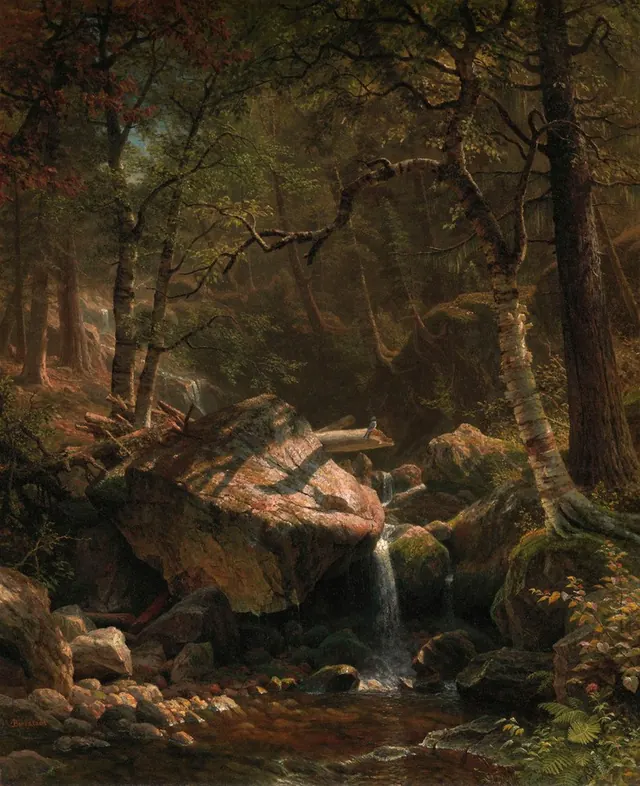
Albert Bierstadt exhibited Mountain Brook in 1863. Critics particularly admired its light and shadow, which made the forest seem strikingly convincing. The setting relates to New England’s White Mountains, then becoming a popular destination. Better known for Western panoramas, Bierstadt offers a close woodland view that might form part of a walk.
The stream descends through several small falls. Pale water leads from depth towards the lower edge, proposing a route through dense surroundings. Stones and reflections grow clearer nearby. The picture draws attention inward and returns it to water immediately before us.
Warm light strikes a large central rock. Branch shadows cross its faces while one side falls almost into black. Such contrasts impressed early critics. Credibility comes from arrangement as well as detail: a selected passage makes form and rock texture exceptionally clear.
A slender trunk on the left crosses lighter depth. Illumination distinguishes several forest planes without opening a broad horizon. The viewer occupies an enclosed place. A woodland walk offers a different intimacy from a mountain panorama, allowing concentrated study of a small space.
A thick dark trunk on the right forms the nearest boundary. Pale peeling birch bark appears beside it. Different trees and surfaces strengthen the impression of direct observation. Diversity remains part of a shared frame around the stream.
A bent branch arches over the water, connecting banks and echoing movement into depth. Natural forms become compositional structure. Comparing historical photographs, the museum proposes that Bierstadt used elements of the Flume in New Hampshire, a popular tourist attraction.
Rounded stones beside the lower stream carry small wet highlights among roots and grasses. Nearby detail makes us almost participants in a walk. Yet no constructed path or crowd connects this view visibly with the region’s actual tourist traffic.
An imaginary composition gathers observations of the White Mountains. Its early success coincided with growing interest in visiting the region. The painting offered an owner a private view of celebrated nature, cleared of other tourists. Exact detail and selective framing work together, allowing a busy destination to appear as a quiet personal discovery.
- Medium
- Oil on canvas
- Collection
- Art Institute of Chicago
- Dimensions
- 111.8 × 91.4 cm
- Accession number
- 1997.365
Sources
Image provided under CC0. Image licence
Adapted and translated from Art Institute of Chicago materials. · Text licence