Mural Fragment Depicting a Maguey Bloodletting Ritual
Unidentified Teotihuacan painter · 500–600 CE
Explore the painting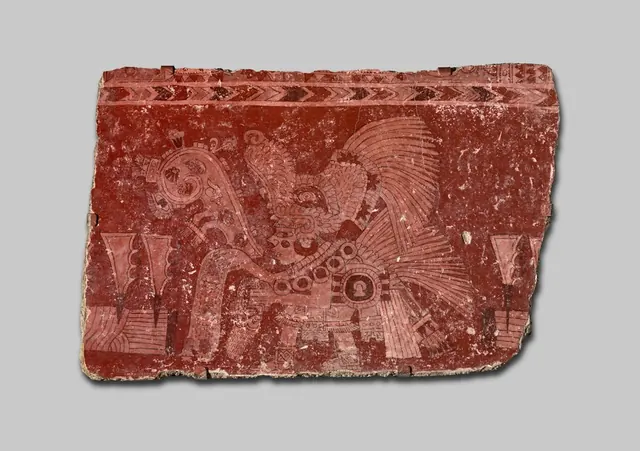
This piece of painted wall came from a palace interior in Teotihuacan, a vast city in ancient Mexico. In the early centuries CE it housed tens of thousands of people, sustained craft production and trade, and built monumental sanctuaries. Rain and harvests supported urban life. The mural shows a request for water taking the form of a complex ceremony involving an offering of blood.
The priest advances in profile beneath a broad, fan-shaped headdress. His costume occupies almost as much space as his body, immediately distinguishing a ritual participant. He is identified through his role, expressed by dress, ornaments and objects held in the hands. The image does not allow us to reconstruct an individual's appearance or name its painter.
A large scroll emerges from the mouth. Shells and plant forms appear inside it. In the museum's interpretation this is visible speech, a prayer for water and fertility. Sounds become pictorial signs. The scroll therefore needs to be read with the priest's figure, even though it resembles an independent ornament.
A circular ornament at the shoulder repeats rounded forms elsewhere in the costume. Fine drawing remains legible against the red field. There is little of the shading that would turn the figure into a solid body. Instead, contour, repetition and the orderly placement of significant objects make the ritual image clear.
An extended hand holds a bag for incense. The other makes an offering associated with water and flowers. Sharp maguey leaves were used for bloodletting; the museum relates motifs before the figure to this practice. Blood offerings formed part of the relationship between people and the divine forces on which agricultural life depended.
The ornament at the top runs in an unbroken band. Originally, similar ritual figures repeated around a painted chamber. The border connected them into an ensemble. Displayed as a separate fragment, the work no longer communicates its former scale: the imagery surrounded viewers and belonged to the palace architecture.
The foot and hands point in the same direction, suggesting movement in a procession. The museum associates the scene with the renewal of time and a ceremony marking the end of a fifty-two-year calendrical cycle. This is a scholarly reading of the imagery. The fragment does not supply a continuous explanatory inscription of the kind a modern viewer might expect.
Murals decorated palaces, temples and homes in Teotihuacan. This fragment preserves part of an elite residence where ritual was connected with the city's communal life. Damage has removed some details, but the central arrangement remains legible. Figure, speech, plants and offerings unite in a request for the renewed fertility on which the city's welfare depended. Its palace origin raises another question: who mediated between the community and the powers expected to bring rain? Elaborate costume and priestly office permit discussion of religious knowledge and elevated status. They do not, without further archaeological evidence, establish the structure of authority throughout Teotihuacan.
- Medium
- Lime plaster with mineral pigment
- Collection
- Art Institute of Chicago
- Dimensions
- 63.8 × 95 cm
- Accession number
- 1962.702
Sources
Image provided under CC0. Image licence
Adapted and translated from Art Institute of Chicago materials. · Text licence