At Mouquin's
William James Glackens · 1905
Explore the painting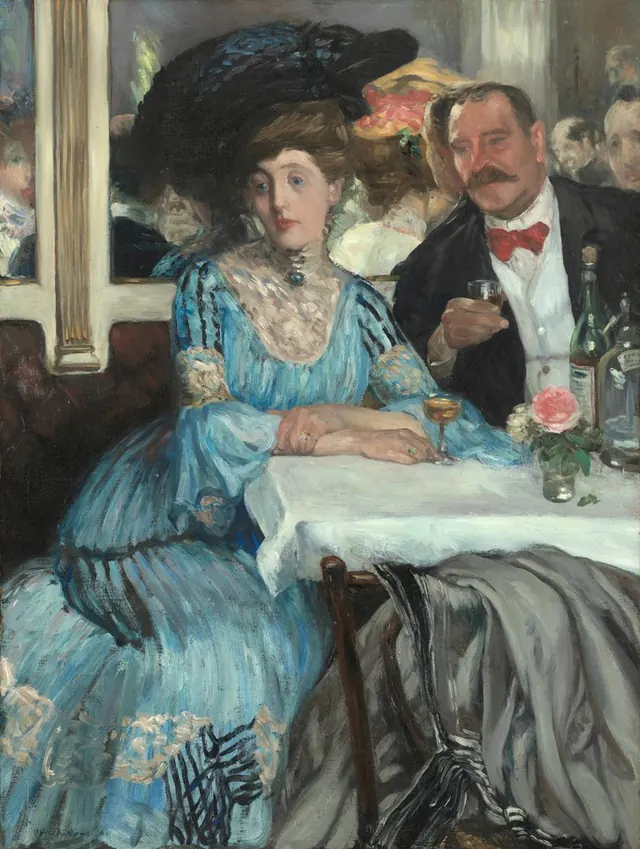
At Mouquin’s restaurant, one might encounter both an artist and the person who would review his painting. William Glackens populated this 1905 scene with acquaintances from his New York circle. Jeanne-Louise Mouquin, the proprietor’s wife, sits with restaurateur James B. Moore. The mirror reflects the artist’s wife Edith and critic Charles Fitzgerald. The customers, painter and potential critical reception belong to one urban milieu.
Jeanne looks aside, leaving Moore outside her line of sight. Her face is painted more quietly and precisely than the gleaming fabric of her dress. Tension develops between the busy restaurant and the still person. Her pause accommodates several readings, from distraction to distance within sociable company.
Moore turns towards her with a small glass in his hand. His posture connects the pair, although she makes no answering movement. Glackens combines portraits of acquaintances with a genre scene of familiar public leisure. Divergent directions and divided attention sustain the encounter.
Moore’s red bow tie and white shirtfront remain conspicuous beside the bright dress. Clothing contributes to restaurant self-presentation. A fashionable establishment offered a place to observe others while being seen oneself. Dress therefore belongs to the subject of city life.
The small glass sits between Moore’s hand and white shirt. It gives him a specific action at the table. Glackens painted contemporary streets and familiar amusements, expanding the range of subjects considered suitable for a large painting. Everyday encounters acquired a scale formerly associated with more ceremonious themes.
Another pair appears in the mirror behind the main figures. Edith Glackens and Fitzgerald enter indirectly, through reflection. The critic supported the artist’s work. The mirror thus preserves a real network through which art was made, discussed and brought before an audience.
Jeanne’s hands rest together on the table. Her horizontal forearms steady the figure amid the rapid brushwork of dress and reflections. A pause develops within the busy surface. We can dwell on a person even as numerous shiny objects compete for attention.
Bottles, glasses and a flower cluster tightly on the right. The table projects towards us, while clothing partly covers the nearest chair. This arrangement makes the viewer a possible member of the company. Entry into this world nevertheless presupposes time and money for a restaurant evening, resources many New Yorkers lacked.
Broad, free movements describe the blue dress. Its luminous fabric occupies much of the foreground, turning fashionable clothing into the principal painterly event. Individual strokes sometimes become ribbons or folds and sometimes remain visibly paint. Observation and freedom of execution meet in Glackens’s modern approach.
Glackens later joined the Eight, who challenged the restrictions of the academic exhibition system. His interest in the city included comfortable leisure. At Mouquin’s shows how urban realism could examine social connections, taste and awkward pauses at an elegant table alongside street life and work.
- Medium
- Oil on canvas
- Collection
- Art Institute of Chicago
- Dimensions
- 122.4 × 92.1 cm
- Accession number
- 1925.295
Sources
Image provided under CC0. Image licence
Adapted and translated from Art Institute of Chicago materials. · Text licence