Willow Bridge and Waterwheel
Hasegawa Sôya · c. 1650
Explore the painting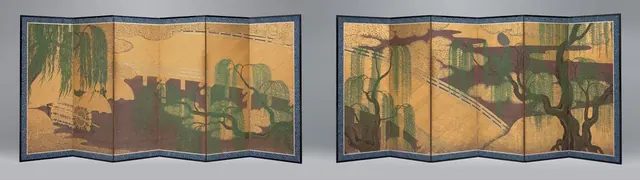
A bridge extends across the twelve panels of two screens painted by Hasegawa Soya around 1650. The place is Uji, a celebrated site between Kyoto and Nara. Japanese viewers could recognise it through the bridge, willows, moon and waterwheel familiar from poetry. A detailed topographic map was unnecessary. Painting drew on a memory of place shaped by centuries of literature.
A waterwheel appears on the left. Its spokes and paddles are carefully distinguished, but a working structure becomes a golden pattern. Raised passages used a white pigment made from shells, covered with gold paint. A practical object thus acquired a physically tangible preciousness within the image.
Long willow branches descend over the water. Their fine green lines differ from the bridge’s dense golden surface. The willow belongs to Uji’s traditional imagery. It is both a recognisable plant and a sign of a literary landscape that viewers could extend through remembered verse.
The bridge deck spreads broadly across the left screen. Gold leaf was applied diagonally to accentuate its curve. The material describes form while retaining its own brilliance. This expensive furnishing allows painted architecture and the actual decoration of the surface to reinforce one another.
On the right screen the bridge advances towards the viewer. Foreshortening makes its immense arc almost tangible. Soya was the son of Hasegawa Tohaku, a master of large-scale painting. The work continues that tradition of organising broad surfaces through a powerful form linking many panels.
Rock-filled wicker baskets stand beside the water. Such structures helped stabilise riverbanks. They recall the labour required to maintain a bridge and riverside settlement. Uji’s natural beauty includes human intervention, although the workers themselves are absent.
A moon made with silver appears between the trees on the right. Gold and silver also enter clouds and currents as leaf, particles and paint. Changing illumination would alter the landscape’s appearance. The actual light of the room became one of the conditions of seeing it.
Uji is assembled from poetic motifs, engineering structures and precious materials. The screens could display their owner’s taste and cultivation, while their physical brilliance expressed wealth. Two kinds of recognition coexist. A viewer might identify the celebrated site through cultural memory or experience the bridge and water without knowing any of the poems associated with them.
- Medium
- Pair of six-panel screens; ink, color, gold, and silver on paper
- Collection
- Art Institute of Chicago
- Dimensions
- Each, 175 × 376 cm
- Accession number
- 2002.365.1-2
Sources
Image provided under CC0. Image licence
Adapted and translated from Art Institute of Chicago materials. · Text licence