Equestrienne (At the Cirque Fernando)
Henri de Toulouse-Lautrec · 1887–88
Explore the painting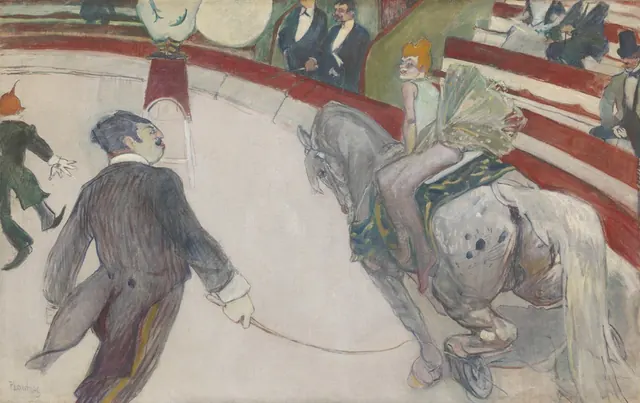
A rider prepares to rise on a moving horse and leap through a paper hoop. Toulouse-Lautrec chose the pause before the feat. At the Cirque Fernando, audiences paid for controlled risk requiring cooperation between performer and animal. This painting of 1887–88 reveals that entertainment through distances, turns and overlapping figures.
The rider looks towards the ringmaster. Scholars suggest Suzanne Valadon, a former circus performer who later became a painter, as a possible model. Her identity remains uncertain. The action itself is clear: the rider attends to the person directing the routine.
Pink skirts and red footwear stand out against the white horse. Costume makes demanding physical labour into an attractive spectacle. The pose appears light, although its continuation will require balance and precise timing. Colour joins professional skill to the demands of a stage image.
The horse lowers its head while crossing the ring. Its body fills much of the canvas and determines the rider’s position. Lautrec drew horses from childhood, before his fascination with Parisian nightlife. Circus imagery connected a familiar subject with modern urban culture.
The ringmaster and his whip loom close to us. His large figure overlaps the horse. He regulates the movement on which the feat depends. The promise of the performer’s free flight rests on a concrete system of commands and control.
The horse’s substantial body is cropped by the edge. Space feels cramped and movement continues beyond the frame. Lautrec abandons a calm overview of the arena. We are close enough to register the animal’s size and its rider’s vulnerability.
Spectators sit behind a barrier, separate from the performers. The division distributes roles and risks. Some watch safely while others provide the event through their bodies. A section of the hoop above the figures indicates the next action and the test the audience expects.
The owner of the Moulin Rouge purchased the painting for his establishment. One entertainment became part of another’s setting. Lautrec’s art participated in Montmartre’s economy, connecting circus, dance hall and artistic publicity. New viewers received the excitement of performance together with evidence of the work sustaining it.
- Medium
- Oil on canvas
- Collection
- Art Institute of Chicago
- Dimensions
- 100.3 × 161.3 cm
- Accession number
- 1925.523
Sources
Image provided under CC0. Image licence
Adapted and translated from Art Institute of Chicago materials. · Text licence