Virgin and Child
Hans Memling · c. 1485
Explore the painting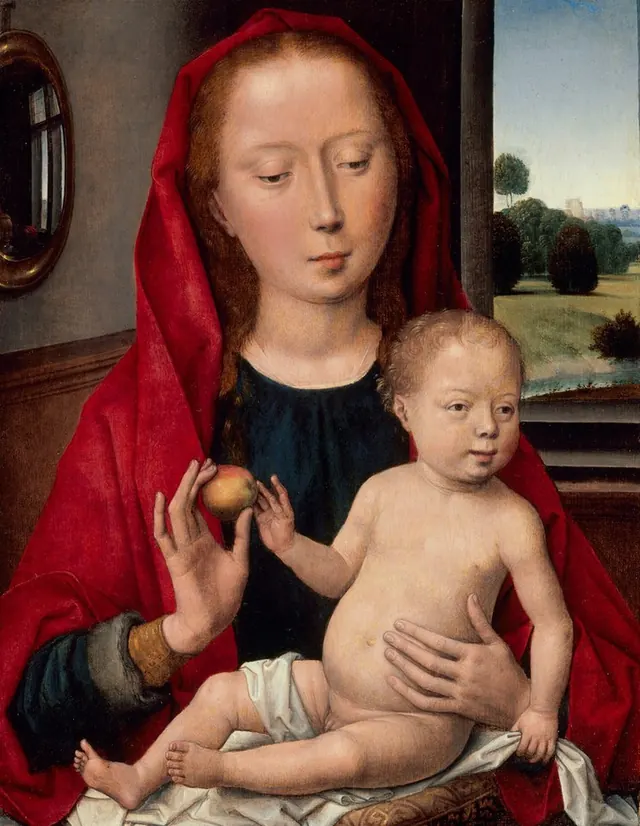
Mary offers an apple to a child in what looks like a domestic chamber. Around 1485 Hans Memling painted this small panel for a hinged devotional image. A praying man occupied its companion panel. Opening the diptych, its owner saw himself beside sacred figures. The intimacy that now resembles a domestic scene belonged to private prayer.
Mary lowers her eyes towards the child. Her red cloak fills much of the lower panel, providing a stable foundation. Memling worked in Bruges, where portraiture and religious imagery could form a single commission. An individual acquired a place within the Christian story of salvation.
The infant turns right, towards the companion wing absent from this isolated image. A praying man occupied that panel. Christ’s gaze linked the diptych’s two halves. To see the connection, we need to imagine both panels opened together. A separate reproduction hides the person towards whom the child turns.
The apple rests between mother’s and child’s hands. Its rounded form rewards attention almost as closely as a face. Such tangible precision brought a sacred encounter within reach of someone familiar with rooms, food, clothes and touch. Everyday sensory experience could support religious imagination.
Mary’s fingers support the infant’s belly while his legs hang freely. Christ appears as a baby dependent on maternal care. For a Christian viewer, this bodily vulnerability belonged to the doctrine of the Incarnation, the belief that God truly assumed human nature.
A tiny foot nearly reaches the lower edge. The body’s proximity to the frame reduces its imagined distance from the viewer. Similar crossings appear on this diptych’s companion wing. Memling stages an encounter between the owner’s world and the devotional image.
Trees and a distant landscape appear through the window. The room is sheltered yet connected to the world outside. Its setting differs from the gold ground of an altarpiece. These sacred figures inhabit surroundings an owner could associate with home.
Two children appear in the small convex mirror on the left. The museum suggests that they may be the donor’s children. In that reading, family remembrance enters the prayer beyond its main participants. The mirror extends the room and includes people outside our direct view.
The closed diptych looked different. Saint Anthony of Padua survives on the reverse of its companion wing, painted in grey to resemble sculpture. Opening the object took its owner from this restrained exterior to a colourful encounter with Mary and Christ. A separate museum panel loses that movement of hands and alternation of surfaces. Its original meaning depended on use.
- Medium
- Oil on panel
- Collection
- Art Institute of Chicago
- Dimensions
- Framed, 41.1 × 33.4 cm
- Accession number
- 1933.1050
Sources
Image provided under CC0. Image licence
Adapted and translated from Art Institute of Chicago materials. · Text licence