The Bay of Marseille, Seen from L'Estaque
Paul Cezanne · c. 1885
Explore the painting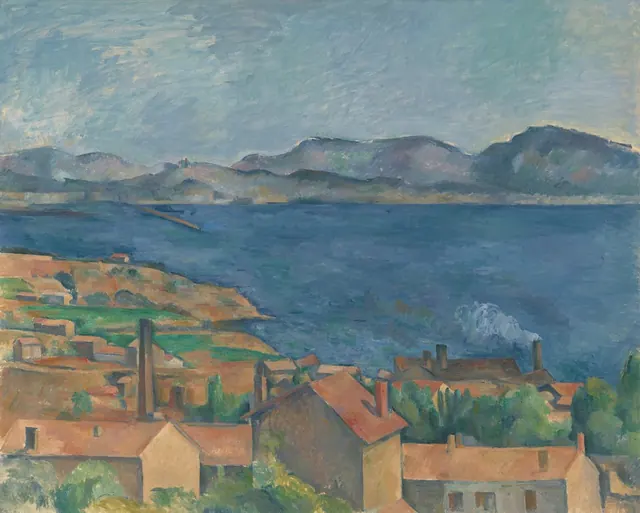
Marseille’s bay opens beyond the roofs of L’Estaque. Cezanne repeatedly returned to this view during the 1880s. In a letter to Camille Pissarro he compared the local landscape to a playing card, noticing its simple large shapes and colours. Strong southern light clarified the coast’s major parts. A familiar place became an investigation of colour building space.
Blue water occupies the broad centre. The surface looks almost flat, yet variations convey distance. Cezanne assembles the sea from small strokes that never entirely disappear. We perceive the bay while noticing a painted canvas.
Mountains across the water separate sea and sky. Cool slopes share blues and greens with the bay. Similarity connects distant planes. Depth develops through related tones and through forms placed above one another.
Foreground roofs form a dense arrangement of tilted planes. Orange and reddish surfaces contrast with blue water. Houses give the view a human scale while people nearly disappear. Attention centres on a built environment that has already transformed the coast.
Pale smoke rises from a chimney on the right. L’Estaque supported industrial production, including roof tiles. Cezanne depicted its factories elsewhere too. Labour and industry belonged to this coast before it became a celebrated painterly motif.
Green land adjoins buildings and chimneys. Natural and constructed forms enter a shared colour order. An industrial place consequently appears harmonious. This view reveals structural beauty while leaving noise, smells and working conditions outside the picture.
Short diagonal strokes build the sky, continuing the brushwork visible in mountains and water. Cezanne avoids giving air a completely separate manner of painting. A common system of touches links every plane.
Such landscapes later attracted artists developing Cubism. Compact space and objects understood as connected planes offered possibilities. Yet this remains a particular coast where factories, houses and sea coexisted. A new pictorial structure emerged through selective attention to a real place.
- Medium
- Oil on canvas
- Collection
- Art Institute of Chicago
- Dimensions
- 80.2 × 100.6 cm
- Accession number
- 1933.1116
Sources
Image provided under CC0. Image licence
Adapted and translated from Art Institute of Chicago materials. · Text licence