Group Pilgrimage to the Jizo Nun
Ike Taiga · 1755/65
Explore the painting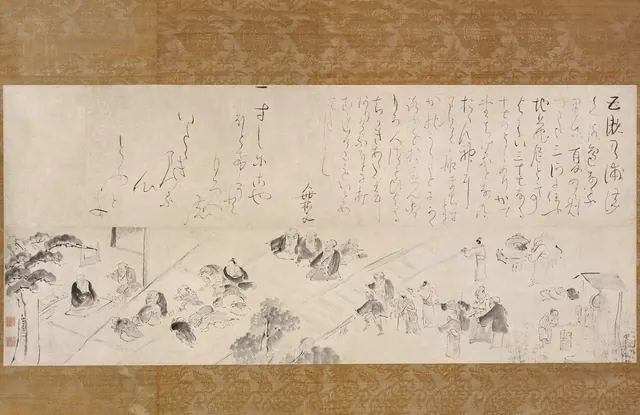
Ike Taiga depicts visitors arriving to see the Jizo nun. She was believed able to communicate with the bodhisattva Jizo, who could assist beings in the afterlife. Above the drawing the artist added an account of the encounter and a poem. Religious pilgrimage becomes an observation of contemporary Japanese life.
The nun sits on a raised area at the left. Dark clothing distinguishes her from the paler visitors. A little space remains around her, while pilgrims gather more closely before the platform. Position identifies the principal figure without exceptional size or a lavish setting.
People bow low before her. Curved backs and heads form a sequence of different postures. Taiga attends to the physical actions of worship: kneeling, bending and finding room among others. Ordinary visitors' movements convey the religious encounter without an invented miracle.
Another seated group appears slightly higher. A few lines distinguish shoulders, headgear and turned faces. Little fills the spaces between them. Each small gesture therefore gains independence, and the viewer gradually discovers different reactions and activities within the crowd.
On the right people are still standing and conversing. Their positions differ from those already bowing before the nun. The encounter develops through successive actions present on a single sheet. We can follow it from the road to the platform, or from the nun towards those still approaching.
Travel equipment and bundles recall the journey. Taiga's inscription describes arriving by boat and people of different social positions coming to worship. Writing supplies circumstances that the drawing alone could not establish. It remains a participant's account, however, rather than independent proof of the nun's supernatural abilities.
Free cursive writing occupies the upper part. Taiga practised painting, calligraphy, poetry and seal carving. These activities meet here: the inscription preserves his voice beside the depicted visitors, while the character of its lines connects writing and drawing. Reading and looking become parts of one work.
Irregular touches of ink describe the foliage. Taiga experimented with tools, including finger painting. For this particular work the museum cautiously suggests twists of paper charged with ink. The exact technique remains disputed. Unusual texture alone does not conclusively settle the alternatives.
Taiga renewed nanga, Japanese painting associated with Chinese literati culture, by introducing local subjects and humour. The relaxed postures here can seem both amusing and attentive to participants in worship. These readings require neither an exclusively mocking artist nor an unquestioning preacher. The drawing lets us observe the pilgrimage, while the inscription invites comparison with his own account.
- Medium
- Hanging scroll; ink on paper
- Collection
- Art Institute of Chicago
- Dimensions
- 54.9 × 123.2 cm
- Accession number
- 2005.168
Sources
Image provided under CC0. Image licence
Adapted and translated from Art Institute of Chicago materials. · Text licence