Hercules and the Lernaean Hydra
Gustave Moreau · 1875–76
Explore the painting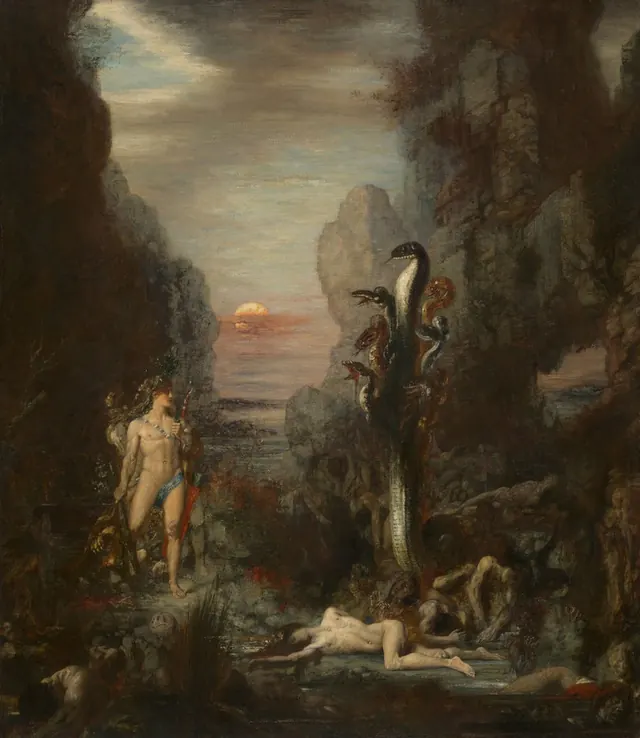
Hercules pauses before the Lernaean Hydra among its victims. Gustave Moreau exhibited the painting at the Paris Salon of 1876. The myth concerned one of the labours assigned to atone for killing his own family. Moreau chooses the interval before combat, when stillness permits close attention to danger. After the war with Prussia, this ancient subject could acquire contemporary resonance.
Hercules stands at the left, almost naked and holding weapons. His small, pale figure contrasts with the dark cliff. The body stays clear within elaborate surroundings. He must act in a world already marked by the consequences of previous encounters.
Serpentine heads rise above one another. Moreau studied animals, produced numerous preparatory drawings and sketched snakes at the Paris menagerie. The Louvre preserves a viper study annotated “Hydra.” Observation of real nature helped give the fantastic creature conviction.
Bodies and remains occupy the foreground. They establish the danger before fighting begins. We witness consequences the hero must end. Yet the elaborate beauty of the painted surface sits uneasily beside its violence.
An orange sun appears in the distance. Light deepens the enclosed ravine rather than clearly opening an escape. The space looks ancient and nearly deserted. A carefully constructed landscape sustains the expectation of decisive action.
Dark vegetation and detail cover the cliff on the right. Precise drawing meets thick, obscure paint. The world becomes tangible and mysterious at once. This approach contributed to art later associated with Symbolism, which explored meanings and experiences beyond a literal event.
The museum offers a possible political reading: Hercules as France and the Hydra as Prussia after the defeat of 1870–71. The painter’s intention is unproven, so this remains an alternative to the mythological account. It raises the question of how national culture turns war into a confrontation of hero and monster. The picture permits that comforting division, while its many dead preserve the cost of such stories.
- Medium
- Oil on canvas
- Collection
- Art Institute of Chicago
- Dimensions
- 179.3 × 154 cm
- Accession number
- 1964.231
Sources
Image provided under CC0. Image licence
Adapted and translated from Art Institute of Chicago materials. · Text licence