I'timad-ud-Daula's Tomb at Agra
Unidentified Indian painters · c. 1820
Explore the painting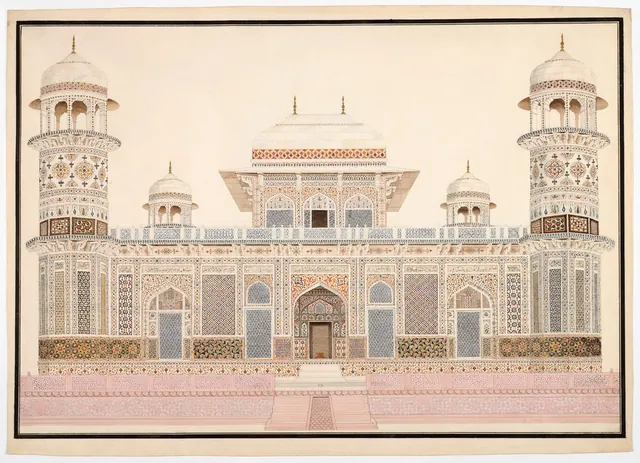
Made around 1820, this watercolour depicts the tomb of Itimad-ud-Daula in Agra. Nur Jahan commissioned the mausoleum in 1622–28 for her father, Mirza Ghiyas Beg, Emperor Jahangir's chief minister. Itimad-ud-Daula, Pillar of the State, was his honorific title. Almost two centuries separate building and picture, during which power and the audience for such images changed.
The upper pavilion occupies the central axis. Its broad roof and small finials differ from the familiar image of a mausoleum crowned by a vast dome. Preserving these features makes the building identifiable. White surfaces also reveal minute coloured decoration.
An arch and elaborate ornament surround the main entrance. A nearly frontal viewpoint clarifies symmetry. The dark opening suggests interior depth, but attention concentrates on the façade. This detailed exterior tells us little about visiting the tomb or ceremonies held there.
The left corner tower is divided into bands. Geometric and plant motifs change between levels. The picture gathers details that an actual visitor would inspect from different distances. Such organised clarity serves interest in monuments as objects of description and comparison.
The right tower repeats the structure, with more distant parts visible behind it. Depth remains despite the ordered architectural presentation. Relatively modest dimensions accompanied exceptional decorative luxury. The tomb testified to Nur Jahan's resources and influence as well as family remembrance.
Coloured inlays in white marble and pierced screens create a dense pattern. Stone inlay and carved latticework required specialised expertise. Watercolour translates that labour into lines and marks on paper. Behind the patron's known name stand many craftspeople whom this sheet does not identify.
Steps lead towards the central entrance without people on them. Their emptiness makes the structure fully available to the eye. Everyday relationships disappear: visitors moving, maintenance and rules of access.
The museum identifies the work with Company painting. During the late eighteenth and early nineteenth centuries, such views served European clients collecting information about India. Before photography, detailed drawings recorded monuments. Local skills adapted to a new market and an appetite for classification. Two related histories meet here. The mausoleum embodied a powerful woman's remembrance of her father; the later drawing made it portable knowledge for another audience. Precision does not make the view historically neutral. We can admire craftsmanship while asking how a monument's meaning changes when separated from local life and gathered into an illustrated collection of a country.
- Medium
- Watercolor on paper watermarked J. Whatman with pencil, pen, ink and gold
- Collection
- Art Institute of Chicago
- Dimensions
- 51 × 74 cm
- Accession number
- 2011.284
Sources
Image provided under CC0. Image licence
Adapted and translated from Art Institute of Chicago materials. · Text licence