Eve
Lucas Cranach the Elder · 1533–37
Explore the painting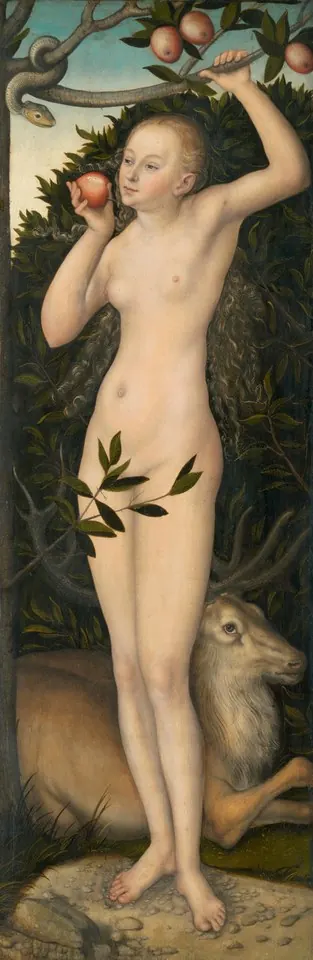
This Eve was paired with an Adam. Together the two narrow panels presented the first humans at the moment of temptation. Cranach spent much of his career at the Saxon elector's court, and his workshop repeatedly painted the subject. In this version of 1533–37, biblical narrative meets a courtly ideal of beauty: a slender, supple body with a carefully defined silhouette.
Eve turns towards the companion panel. Her gaze anticipates Adam beyond the present image's boundary. Seen alone, she appears to look into empty space. A separate reproduction alters the relationship between the figures, making knowledge of the pair essential even to this small gesture.
She raises a red fruit bearing a bite mark. The forbidden act has already begun. Genesis does not name the kind of fruit, although European art often represents an apple.
The other arm reaches towards a branch, continuing the body's long curve. The museum relates such proportions to courtly ideals in Cranach's period. This helps explain why his figure does not seek the physique of an antique statue, despite his engagement with Dürer's treatments of Adam and Eve.
A serpent coils around the upper branch and lowers its head towards the woman. Together with the fruit it identifies temptation. The scene remains outwardly calm. Its moral significance depended on the viewer's knowledge of the Fall rather than panic or punishment shown within this panel.
A deer rests behind Eve's legs, placing the first humans among other creatures in Eden. It also separates her pale silhouette from dense dark vegetation.
A branch crosses the middle of the figure and conceals part of the body. It belongs to the garden while also regulating what the viewer can see. Two compatible ways of looking emerge: a biblical prohibition and a carefully presented nude beauty. Their coexistence invites discussion of what kinds of viewing a religious subject permitted.
Bare feet rest on stony ground. Crisp drawing continues far from the face and identifying attributes. The narrow format contains the entire body, from raised hand to toes. Narrative can therefore coexist with a sustained study of the human silhouette.
Repeated versions of Adam and Eve reflect a large workshop and demand for a familiar subject. Dürer supplied an important precedent, yet Cranach's figures differ. This difference reveals how distinct artistic environments adapted one story to their own preferences and ways of depicting the body.
- Medium
- Oil on panel
- Collection
- Art Institute of Chicago
- Dimensions
- 107.5 × 36.4 cm
- Accession number
- 1935.295
Sources
Image provided under CC0. Image licence
Adapted and translated from Art Institute of Chicago materials. · Text licence