The Herring Net
Winslow Homer · 1885
Explore the painting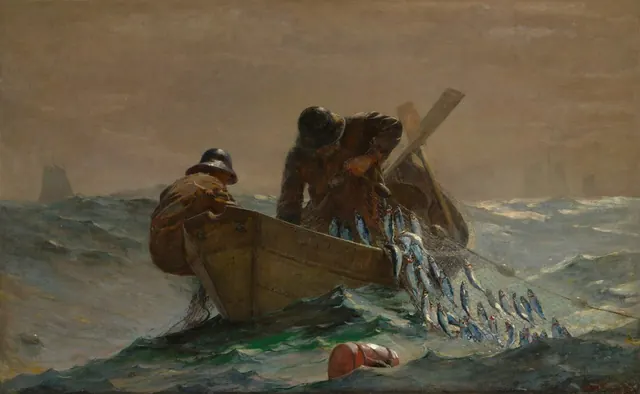
In 1881 Winslow Homer worked in the fishing community of Tynemouth on the English coast. The experience changed his painting for years to come. In 1885, at Prouts Neck in Maine, he painted two people hauling a herring net. Labour appears large and close, with water occupying almost the whole surrounding world and the shore outside the frame.
The figure on the left sits with a back towards us, braced beside the gunwale. The museum allows that this may be a boy but does not establish the age conclusively. This figure receives the catch while the other hauls the net. Different tasks form one operation, and each person's position depends on the other's actions.
The fisherman on the right bends his whole body forwards. His face is largely hidden, while his curved back, shoulders and arms remain clear. Homer communicates exertion through its physical mechanics. We do not need to invent personal characteristics to understand a wet net's weight and the difficulty of balancing.
Silver fish flash among the dark mesh. Repeated pale forms reveal the purpose of the work. The catch itself increases the weight that must cross the gunwale. Its glitter can be enjoyed as paint, but within the scene it represents the material result of labour and a prospective income.
The hull rises above a wave and is partly concealed by water. The occupants must balance without interrupting their work. The gunwale's diagonal connects their bodies with the slope of the sea. Homer's low viewpoint surrounds even a small boat with a large and shifting environment.
A reddish barrel appears at the lower edge, partly submerged by a wave. This nearby detail helps establish our distance from the boat and the water level. The viewpoint supplies no comfortable position on shore; it brings us closer to the conditions in which the work occurs.
An oar behind the fisherman points upwards to the right. Its long straight form stands out among the curves of net, hull and waves. The boat requires management even while hands are occupied with the catch. Such details connect individual exertion to the small vessel on which safety depends.
Sailing ships appear along the horizon. The fishermen work far from them, with intervening water emphasising the distance. These silhouettes also keep the scene connected to economic activity. The small boat belongs to a larger fishing enterprise, although its occupants alone dominate the foreground.
The museum describes this as a heroic image of daily labour. That heroism can be considered alongside vulnerability. Large scale elevates the workers, while the boat's tilt and obscured faces suggest how little of their surroundings they control. Attention to the beautiful light on the catch can shift towards the conditions under which people obtain it.
- Medium
- Oil on canvas
- Collection
- Art Institute of Chicago
- Dimensions
- 76.5 × 122.9 cm
- Accession number
- 1937.1039
Sources
Image provided under CC0. Image licence
Adapted and translated from Art Institute of Chicago materials. · Text licence