Madame Roulin Rocking the Cradle (La berceuse)
Vincent van Gogh · 1889
Explore the painting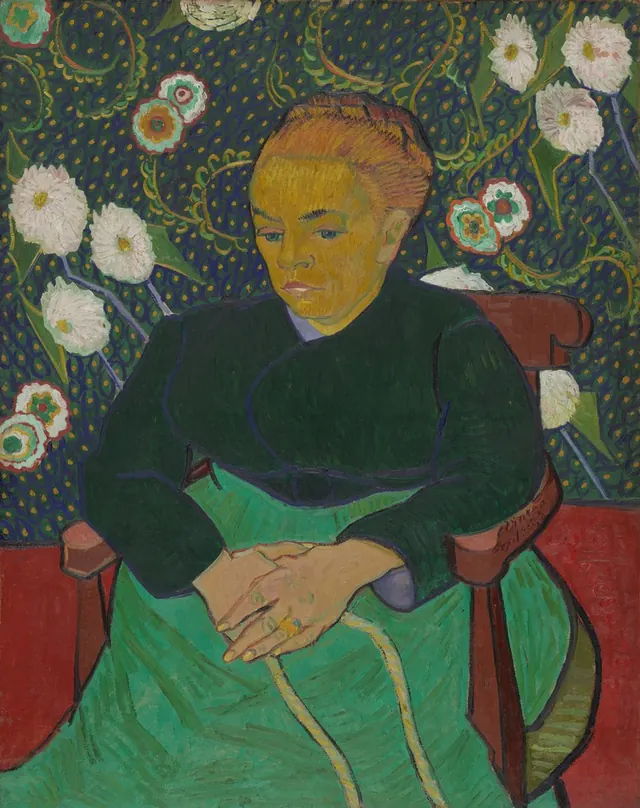
Augustine Roulin holds a cord connected to a cradle outside the picture. Van Gogh called the image La Berceuse, or Lullaby, and painted five versions. The Roulin family represented an intimacy and stability he sought himself. Chicago's version dates from January 1889, following hospitalisation and the difficult end of his shared life with Gauguin in Arles.
Large hands rest together in her lap. Dark and coloured lines define the fingers without smoothing them into academic finish. The portrait preserves a familiar woman's particular activity. Van Gogh also gave it the broader meaning of maternal consolation discussed in connection with the series.
The cord passes between her fingers and continues downward. An unseen cradle explains it and extends the action beyond the canvas. Without this detail, her posture might suggest ordinary rest. The child remains outside our view, yet determines the image's title and purpose.
Reddish hair forms a dense rounded shape around the head. Short strokes follow its direction. Warm colour stands out against green, while a firm outline holds the form amid a restless pattern. Large colour relationships establish both recognition and expression.
The yellow-green face stands out among green clothing and wallpaper. Van Gogh sought what he called a lullaby in colours. Consolation was to emerge from the entire arrangement linking the person with surrounding pattern. A familiar woman’s portrait became an independent image of care that he would propose accompanying with sunflowers.
The reddish-brown chair belonged to Gauguin. After his departure, the familiar object entered a new portrait. The museum proposes reading Augustine occupying it as a response to the friend’s absence. This interpretation connects a domestic scene with hopes of renewed closeness. A few months later Van Gogh would give this very painting to Gauguin.
Wallpaper flowers almost surround her head. Their pattern flattens depth and brings the figure close to the decorative surface. Green clothing, red flooring and the multicoloured background form forceful combinations. Repetition, rhythm and colour were intended to console, although another viewer might experience the intensity as stimulating.
Van Gogh gave this version to Gauguin in May 1889. He also proposed hanging La Berceuse between two sunflower paintings. The portrait could form an ensemble and help sustain a friendship. Augustine remains a real person whose everyday care became the artist's ideal. Her visible activity, his hope and our response to colour are distinct levels that all contribute to the painting.
- Medium
- Oil on canvas
- Collection
- Art Institute of Chicago
- Dimensions
- 92.7 × 73.8 cm
- Accession number
- 1926.200
Sources
Image provided under CC0. Image licence
Adapted and translated from Art Institute of Chicago materials. · Text licence