Yang Pu Moving His Family
Unidentified Chinese painters · Yuan dynasty (1279–1368) 元朝
Explore the painting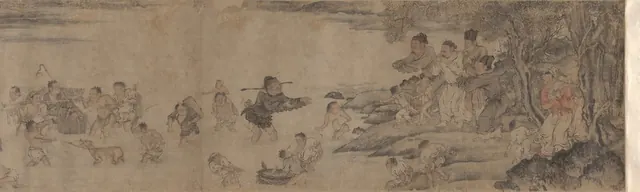
A family's move becomes a procession of practical difficulties. People cross a shallow river carrying children, animals and household possessions while farewells continue on the bank. The man in official headgear may represent Yang Pu, a character in Chinese stories of the twelfth and thirteenth centuries. In these accounts he first declined office, then reluctantly accepted an appointment in the capital.
At the centre of the crossing a man spreads his arms to balance. Water conceals his legs, and carrying belongings demands care. The painter develops the journey through individual difficulties. A long handscroll allows viewers to follow these actions successively rather than concentrate on a single formal farewell.
Men gather on the right bank. Their caps and reciprocal bows distinguish the leave-taking from the work of the carriers. For a Chinese official an appointment could mean a long separation. To limit local loyalties and corruption, officials were prohibited from serving in their home districts. Moving across the vast country could make reunion with friends unlikely.
The long streamers of an official cap help identify a participant's social position. Some details resemble twigs. The museum suggests a possible reference to the custom of giving a departing friend a willow branch. This remains an interpretation, but it shows how a familiar sign could add literary meaning to a domestic episode.
Figures beside the tree crowd a small stretch of bank. They turn towards one another while possessions are already being carried across the water. Different rhythms coexist: a lingering conversation and the work of people who must move on. Their mismatch creates humour without requiring invented dialogue.
An animal is led through the water at the lower left. A whole household moves with the family. The appointment concerns one official, but its consequences extend to many people and possessions. The painter makes that dependence visible by distributing the participants all the way across the river.
The group on the left is already crossing. Children and bundles carried on shoulders and heads alter ordinary postures. The museum identifies scrolls, dishes and animals among the possessions. The future official's scholarly pursuits thus inhabit the same material world as household utensils and family responsibilities.
A small boat in the lower section adds another way of crossing. Pale intervals of water separate groups and allow each to be read individually. Fine ink lines and light colour preserve many small movements. Gradually exploring the long image lets each new detail modify our understanding of the move.
Parting from a departing friend was a serious subject in Chinese poetry and painting. This unidentified Yuan-dynasty painter approaches it through practical complications and almost caricatural poses. Yang Pu remains a probable identification. Even without a conclusive name, the scroll reveals the cost that an honourable government appointment could impose on a family and its friends.
- Medium
- Handscroll; ink and light color on paper
- Collection
- Art Institute of Chicago
- Dimensions
- 52.7 × 231.1 cm
- Accession number
- 1952.9
Sources
Image provided under CC0. A detail of the scroll is shown. Dimensions refer to the work catalogued by the museum. Image licence
Adapted and translated from Art Institute of Chicago materials. · Text licence