Virgin and Child with an Angel
Sandro Botticelli · 1475–85
Explore the painting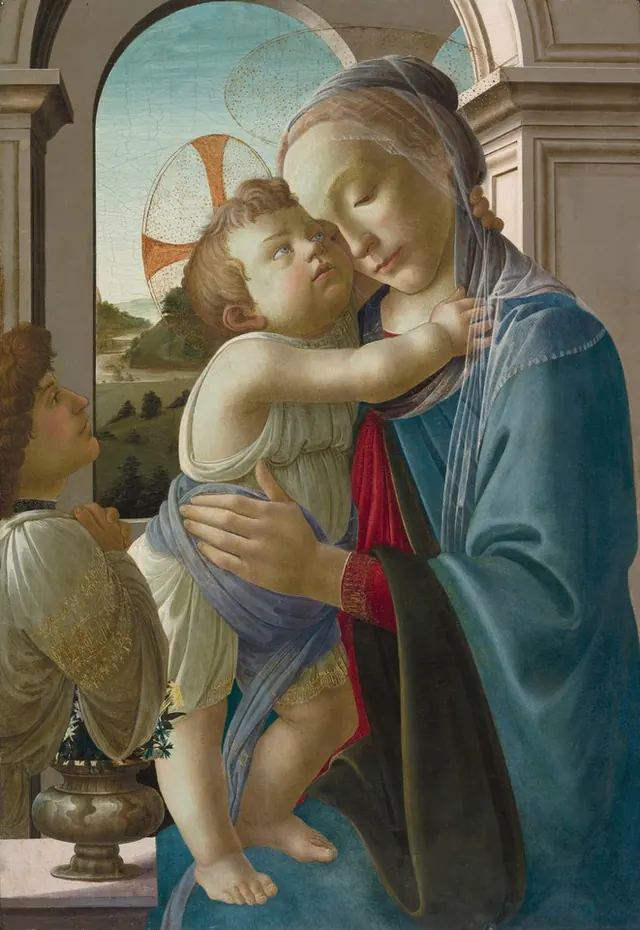
Mary presses her cheek to Christ as he embraces her neck. Botticelli painted this image in 1475–85. A familiar maternal movement becomes the basis of religious painting. Fine gold halos and a praying angel establish sanctity, while hands, cheeks and folds bring it close to bodily experience. The relationship itself invites sustained attention.
Beneath a transparent veil Mary lowers her face towards her son. Fabric crosses hair and cheek without concealing a soft contour. Botticelli joins an idealised smooth face with close material description. The eye follows her profile and a nearly weightless layer over it at once.
Christ lifts his face to hers and their cheeks meet. Rounded infant features contrast with Mary’s longer face. Their heads form a close centre within a tall architectural arch. Surrounding space appears chiefly at the edges, intensifying intimacy.
The child’s arm encircles her neck. Fingers lie beside the veil, joining heads and shoulders in one group. The museum emphasises Botticelli’s tactile painting. Sacred meaning emerges through an action familiar to viewers who know the care of children.
Mary supports her son’s body. Long fingers stand out against pale fabric and blue drapery. Support has a clear physical role and determines the composition. The child can rise towards her face because her hand maintains his balance.
An angel at the left looks up with joined hands. Smaller scale preserves most of the space for the central figures. The angel also models attentive prayer. Mother and child become an encounter witnessed by a third participant.
A metal vessel stands on the lower ledge. Reflections and a firm rim differ from transparent cloth and soft skin. The hard horizontal separates our space from the figures. Its proximity nevertheless brings the whole scene immediately before us.
Bare feet rest on blue cloth, with toes and rounded heel carefully outlined. From face to feet, expressive contour and touch remain consistent. Infant vulnerability belongs to an image surrounded by golden signs of sanctity.
Celebrated in his own lifetime, Botticelli developed an emotional and tactile manner across religious and secular subjects. Here it serves sacred maternal love. An ideal of care coexists with a devotional invitation to approach Mary and Christ. Both meet in one visible action: a child reaches towards his mother while she holds him close.
- Medium
- Tempera on panel
- Collection
- Art Institute of Chicago
- Dimensions
- 85.8 × 59.1 cm
- Accession number
- 1954.283
Sources
Image provided under CC0. Image licence
Adapted and translated from Art Institute of Chicago materials. · Text licence