The Watermill with the Great Red Roof
Meindert Hobbema · c. 1665
Explore the painting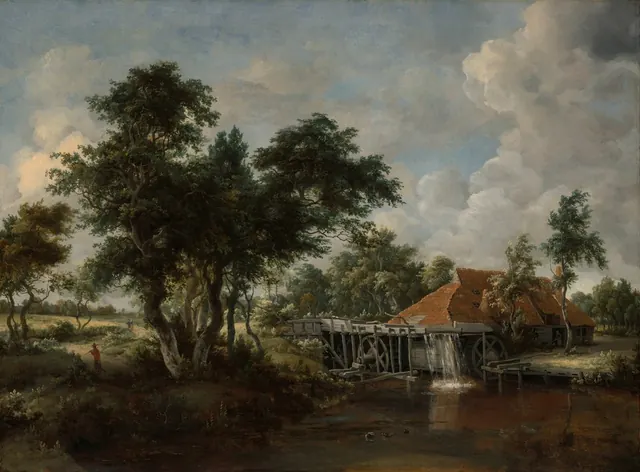
Meindert Hobbema returned to watermills more than thirty times. Painted around 1665, this landscape draws on motifs shared with his teacher Jacob van Ruisdael. A familiar rural building brought moving water, changing light and human labour together. Nature already belongs to a system of everyday work here.
The broad red roof stands out among greenery on the right. Uneven slopes and small windows make the building seem inhabited. Warm colour answers cool grey-blue clouds, while its horizontal reach balances the tall tree at the left. A working mill becomes the landscape’s principal structure without ceremonial architecture.
Water falls between wooden constructions. White streaks and foam make movement visible against darkness. Wheels at either side connect the current with machinery. Beauty and practical use coincide: an energy source appears beside the building that depends on it.
Supports and walkways cross the stream at different levels. Numerous beams reveal the construction needed to use a natural current. Hobbema distinguishes wood, earth and water closely. Familiar detail sustains credibility within a carefully arranged composition.
A large tree covers much of the left half. Dense branches form a canopy, with glimpses of distant road and field. Dark foreground increases the brightness of illuminated areas. Our gaze travels between nearby trunks and mill before discovering small figures along the path.
Well-dressed people walk farther down the road at the left. The Art Institute reads them as rewards of diligence and productivity. Under this interpretation, the mill contributes to a moral image of prosperity. Working machinery and prosperous walkers share a vision of successful countryside.
Clouds occupy almost half the canvas. Their rounded brightness echoes tree crowns, while open sky rises over dense land. Uneven lighting keeps the quiet setting active. Weather alters the building’s appearance as flowing water changes the pond’s surface.
The museum associates Hobbema’s mills with both industry and human transience. These readings give an ordinary mechanism practical and moral dimensions. Their proximity to the distant walk is particularly suggestive. Productivity’s rewards appear peaceful and attractive, while people maintaining the machinery remain outside the principal action. That choice invites discussion of whose view shapes this working countryside.
- Medium
- Oil on canvas
- Collection
- Art Institute of Chicago
- Dimensions
- 81.3 × 110 cm
- Accession number
- 1894.1031
Sources
Image provided under CC0. Image licence
Adapted and translated from Art Institute of Chicago materials. · Text licence