Still Life with Geranium
Henri Matisse · 1906
Explore the painting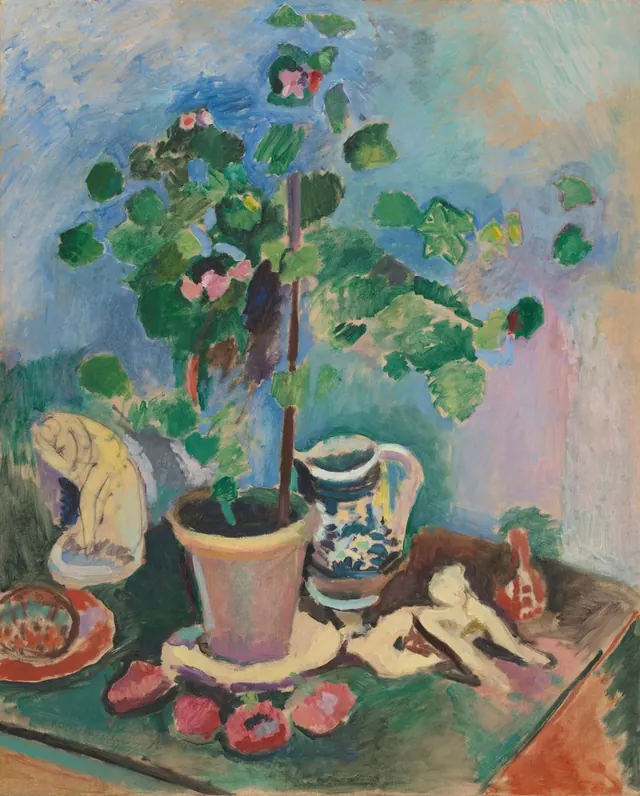
A geranium rises above jugs, vegetables and two small figures. Matisse painted the still life in 1906, soon after critics called him and fellow painters Fauves, “wild beasts,” for their extraordinary freedom with colour. His own sculptures appear among these bold colours. The table connects painting, modelling and everyday objects.
An earthenware pot occupies the centre. Its warm surface acquires pink, violet and greenish tones from the surrounding palette. Matisse keeps the object recognisable without restricting colour to literal description. It belongs both to domestic space and to relationships across the canvas.
Geranium leaves spread through the upper half, leaving pale intervals between them. The plant can resemble a small tree above the figures, giving still life something of a landscape. Differences of scale make an ordinary table suggest another, imagined world.
A patterned jug stands beside the pot. It connects decorative art with the plant and Matisse’s own works. He collected and closely studied objects whose ornament offered possibilities for painting. A manufactured vessel becomes as active in colour as a living leaf.
A figure bending to remove a thorn stands on the left. This is Matisse’s own sculpture. A few lines and patches describe its pale surface. A three-dimensional work returns to two dimensions and changes character. It enters a new experiment while retaining its recognisable pose.
A female figure leaning on her hands lies to the right. She too belongs to Matisse’s sculpture; the museum suggests that plaster versions are shown here. Her pale body stretches among objects, resembling rest beneath plants. One artwork takes on another role inside a second.
Red vegetables create dense colour accents along the lower edge. They reinforce the green tabletop and answer the small flowers above. Ordinary food receives attention alongside sculpture. Traditional rankings of fine art and household things no longer dictate what matters visually.
Matisse studied earlier masters and admired Cezanne while developing a sharply modern language. This table demonstrates continuity through practice. Plant, ceramics, sculpture and colour become materials in one investigation. Artworks continue to change when placed in new surroundings and represented again.
- Medium
- Oil on canvas
- Collection
- Art Institute of Chicago
- Dimensions
- 100.3 × 81.5 cm
- Accession number
- 1932.1342
Sources
Image provided under CC0. Image licence
Adapted and translated from Art Institute of Chicago materials. · Text licence