The Assumption of the Virgin
El Greco · 1577–79
Explore the painting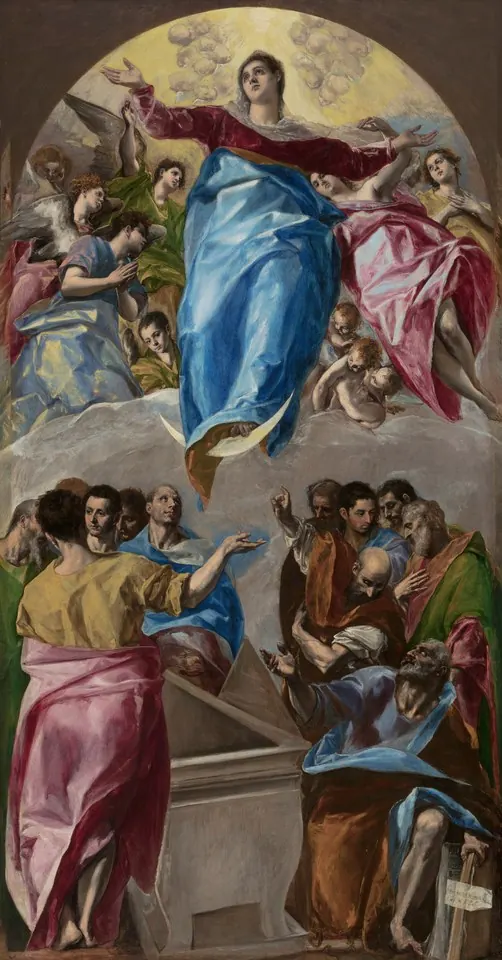
El Greco painted The Assumption of the Virgin in 1577–79 for Santo Domingo el Antiguo in Toledo. It formed the centre of his first major Spanish commission. The church served as the funerary monument of the noblewoman Doña Maria de Silva, so Mary's ascent belonged to a programme linking death with the hope of salvation. The patron's commemoration helped determine the entire altarpiece's meaning.
Mary raises her face and spreads her arms. Her figure fills the upper half of the tall canvas, surrounded by angels beneath an opening of light. The composition carries our gaze upwards, making the viewer's eye movement part of the account of ascent.
Broad folds spread across the blue mantle. Sharp highlights keep them legible at a distance, moving from dark blue towards almost white. The cloth appears animated. Large colour masses operated differently on an altar above a worshipper than during close museum inspection.
The angel on the right turns towards Mary, with pink clothing spreading beside her mantle. The heavenly group attends a single event. The museum contrasts its focus with the apostles' varied responses below. That difference distinguishes earthly witnessing from heavenly reception within the same image.
The apostles surround the tomb. Some look up; others turn to neighbours or open their hands. The miracle gathers people whose responses differ. The museum suggests that these expressive faces may derive from studies of live models. Attention to individuals becomes particularly noticeable beside the angels’ coordinated movement above.
The stone tomb is empty. Catholic tradition holds that Mary was taken to heaven in body and soul. The subject differs from an ordinary death scene and therefore served the church's funerary programme particularly well. Painted stone connects the missing body with Mary's upward movement above it.
Green clothing on the right joins pink, ochre and blue in the crowded group. Broad brushwork and strong colour differences structure the painting. Light selects important gestures as well as describing volume, keeping numerous figures legible within the narrow format.
A museum presents this as an independent work by El Greco. Originally it belonged to an altar ensemble connected with worship and a particular deceased woman. Its relocation sharpens the difference between admiration for a painting technique and the hope for which the image was commissioned. Salvation here concerns both religious teaching and personal commemoration.
- Medium
- Oil on canvas
- Collection
- Art Institute of Chicago
- Dimensions
- 403.2 × 211.8 cm
- Accession number
- 1906.99
Sources
Image provided under CC0. Image licence
Adapted and translated from Art Institute of Chicago materials. · Text licence