The Bewitched Mill
Franz Marc · 1913
Explore the painting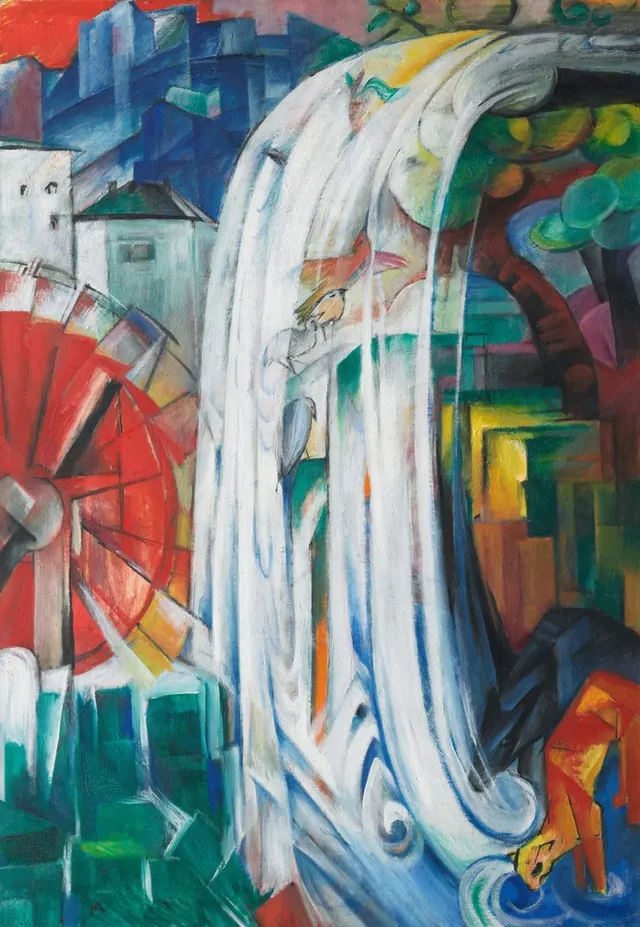
Franz Marc painted The Bewitched Mill in 1913 after visiting Merano in South Tyrol. He was interested in how animals experience their surroundings. That question encouraged a departure from landscapes centred on a human observer. The title relates to an unusual harmony among buildings, water and animals. The painting offers an artistic conception of that harmony; the physiology of animal vision lies beyond it.
A red millwheel occupies the left. Bright angular sections divide its circle, with spokes spreading from a dark centre. Machinery becomes a forceful event in colour. Human activity belongs to this world alongside nature, although no people appear.
A white torrent descends through almost the full height. Small animal forms emerge within it as moving water connects top and bottom. Pale bands overlap other passages and weaken the usual separation of solid objects. The mill begins to resemble a place of transformations promised by its title.
Blue buildings above consist of facets of different intensities. Such geometric simplification connects the painting with European modernism. Recognisable structures change shape and colour to serve the whole composition. Expressionist painting allows these transformations of appearance to convey an attitude towards the world.
A small pale house beside the wheel preserves scale and a recognisable setting. Water and vegetation loom beside it. The tall torrent crosses the space almost independently of the building’s dimensions. An ordinary mill becomes a place where creatures and natural forces receive more attention than human habitation.
Trees on the right consist of rounded crowns and leaning trunks. Colour connects them with buildings and water rather than strictly separating natural and manufactured things. Relationships within the painting matter more than matching every hue to actual light.
A red-and-yellow animal lowers its head towards the water at the lower right. Its outline remains legible while the body joins surrounding colour planes. Marc preserves recognition of a living creature while weakening its separation from the landscape.
Dark green water beneath the wheel consists of angular highlights. Repeated verticals link it with the white torrent, while colour connects it with the right side. The whole surface becomes a related system of movements. This coherence supports Marc’s central conception of nature and human construction belonging to one animated world.
Trying to see through an animal's eyes makes human perspective available for discussion. Yet a human painted this canvas and arranged forms for human viewers. Its strength lies in imagining a different distribution of attention. We can follow water, bodies and colours while leaving open how far that imagined closeness approaches another creature's experience.
- Medium
- Oil on canvas
- Collection
- Art Institute of Chicago
- Dimensions
- Without frame, 130.2 × 90.8 cm
- Accession number
- 1931.522
Sources
Image provided under CC0. Image licence
Adapted and translated from Art Institute of Chicago materials. · Text licence