Altamira bison
Unknown artist · About 15,000–13,000 years ago
Explore the painting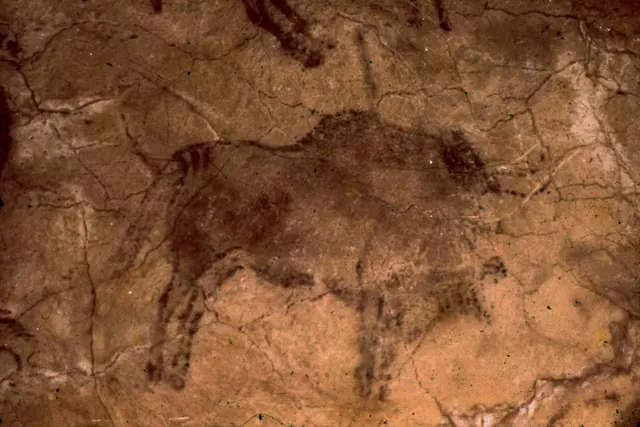
This bison is painted on the ceiling of Altamira Cave in northern Spain. Its multicoloured animals belong to the Magdalenian period, late in the Palaeolithic. Earlier images survive beside them. Different generations decorated the cave, gradually changing its ceiling. This is part of an extensive ensemble made long before farming cities, written histories and the artists whose names we know.
Altamira’s inhabitants hunted for meat, hides and materials for tools. Deer were a particularly important resource. Sinews supplied threads and cords; antlers became implements. Food, clothing and everyday work depended on animals, giving knowledge of their behaviour and anatomy practical value. The paintings preserve another aspect of this relationship — the ability to observe an animal closely and convey its appearance.
The small head drops before a heavy body. A dark contour distinguishes forehead, muzzle and projections even where colour almost merges with stone. The drawing preserves a bison’s particular build. The proportions alone allow recognition, keeping the image legible despite damage and lost pigment. It demonstrates an ability to select a few essential characteristics of a living creature.
The back rises high behind the head and descends towards the hindquarters. A continuous line distinguishes massive shoulders from a narrower rump. This is a demanding solution on an uneven surface. The contour must remain convincing as stone projects, recedes into hollows and catches light differently from one passage to another.
Reddish colour lies inside the dark boundary. Altamira’s researchers describe a sequence for making the polychrome animals. Outlines were engraved and drawn in charcoal, followed by red or yellowish paint. Black lines defined hair and parts of the body. Several techniques worked together, each serving a purpose. Engraving, line and colour together conveyed the body’s structure and the texture of its coat.
The painters used bulges in the ceiling to give animals volume. Stone contributed to the choice of shape before paint was applied. A photograph compresses that relief into a plane, making part of the ancient artist’s work easy to overlook. Seen from below, a body existed both as a coloured image and as a surface projecting above the viewer.
The legs are much thinner than the body. Their lines extend onto lighter stone, suggesting how considerable weight rests on small supports. Within this fragment the bison appears without a hunter or weapon. Close knowledge of an animal does not by itself explain why its image was needed. Here we reach the distinction between what the drawing preserves and what researchers seek to reconstruct.
The Altamira Museum proposes connections between the paintings and communities’ shared ideas, stories and possibly rituals. In that reading, a recognisable animal could help explain humanity’s place among other beings. The stories themselves are lost. Yet the possibility of communicating about animals through images broadens the cave’s history to include transmitted knowledge, shared attention and collective memory alongside obtaining food.
In 1879 María, the daughter of researcher Marcelino Sanz de Sautuola, first noticed the ceiling paintings. He published the discovery, but many contemporaries rejected their Palaeolithic age. Discoveries in other decorated caves helped secure recognition. In 1902 archaeologist Émile Cartailhac publicly acknowledged the sceptics’ mistake. The Altamira controversy also concerned early humans’ capacities. A surviving image forced reconsideration of who could have made such art.
- Medium
- Mineral pigment and charcoal on rock
- Collection
- Cave of Altamira, Cantabria
Sources
CC BY-SA 3.0. Resized previews and tiles prepared for display; no retouching or upscaling. Image licence