The Basket of Apples
Paul Cézanne · About 1893
Explore the painting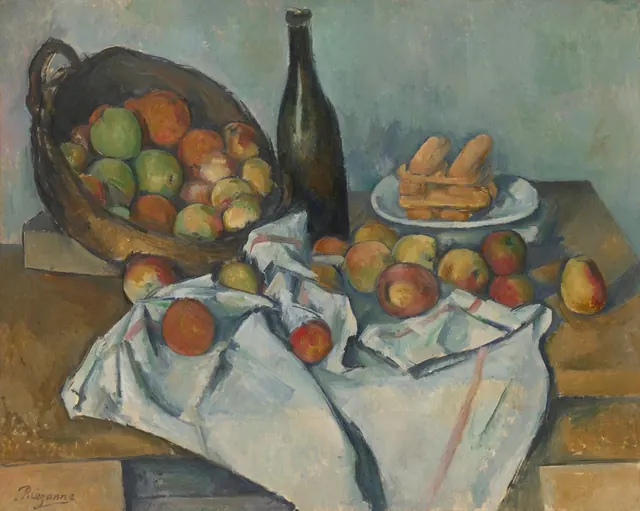
Cézanne painted The Basket of Apples around 1893. Every object is recognisable, yet the table edges fail to align across the cloth. Different viewpoints coexist within one arrangement on the canvas.
The basket tilts, with apples packed against its rim and more fruit scattered below. Cézanne distributes rounded forms between basket and table while conveying the weight of the filled container.
The bottle stands near the middle. Its sides have slightly different inclinations, and dark and greenish patches build its surface. Their relationships give the object volume.
Elongated biscuits sit on the plate. The lower rows are seen more from the side; those above seem tilted further towards us. These shifts expose more of each object’s surface.
The tablecloth hides the centre of the tabletop. On either side, the visible edges sit at different heights. Extend both lines mentally and they cannot form one regular board.
Red, yellow and green areas meet on the apple beside the cloth. Their transitions have not been blended smooth. The colour changes from one side to the other reveal both the fruit’s roundness and the individual brushstrokes.
The cloth’s shadows contain much blue and grey. Pale fold edges run beside dark lines. The white fabric becomes a complex coloured object occupying almost as much of the table as all the fruit together.
In Cézanne’s Post-Impressionism, colour builds volume and perspective permits different viewpoints. The cloth connects the incompatible parts of this table. The artist rarely signed his paintings, but here his signature appears at the lower left.
- Medium
- Oil on canvas
- Collection
- Art Institute of Chicago
- Accession number
- 1926.252
Sources
Open-access Art Institute of Chicago reproduction, CC0. Image licence