The White Path Between Two Rivers
Unidentified Japanese painters · 1200s
Explore the painting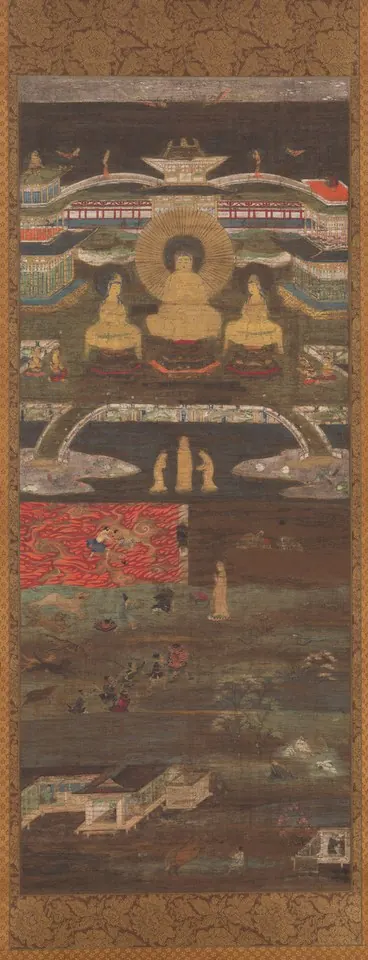
A narrow white road leads between fire and water towards the Buddha Amida. This thirteenth-century Japanese painting explains a parable by the Chinese teacher Shandao. A traveller faces two dangerous rivers while enemies and beasts pursue him from behind. Encouraging voices urge him onward, and trust enables him to reach the opposite bank. The painter unfolds the account across the scroll’s height, from a troubled earthly world to the Pure Land.
At the top, Amida sits between two attendant figures. A great radiant halo distinguishes him among the buildings. Palaces, bridges and pools form an ordered place, sharply different from the painting’s lower half. This is the promised Pure Land, where enlightenment can be approached. Architectural clarity makes a religious promise visible.
Below appears another group of three golden figures. Repeating sacred personages allows a meeting along the way and the destination’s grandeur to occupy one image. Different moments unfold together. The scroll consequently reads as a developing event rather than terrain observed from a single position.
The river of fire rages at the left. In the parable it signifies anger and hatred. Rapid tongues of flame turn an inner condition into visible danger. Such an image lends itself to oral explanation: a teacher could connect familiar irritation with a larger account of salvation. Painting gives emotion an extent and a location.
Beneath the fire, a watery surface can be distinguished. The river of water represents attachment and insatiable desires. Together the rivers surround a narrow crossing, leaving no broad safe route. Salvation is offered here to someone still experiencing powerful passions. The possibility of progress remains within their midst.
A pale figure near the rivers’ boundary helps the eye locate the crossing. Small scenes of earthly life occur nearby, but movement towards the painting’s upper part gradually draws them together. The white path signifies trust in Amida and the aspiration for birth in the Pure Land. Its narrowness conveys the fragility of a resolve challenged by fear, desire and the world left behind.
In Japan, the parable was circulated by teachers including Honen and Shinran of the Pure Land traditions. Its force lies in an unusual understanding of salvation’s possibility. The path is available to someone not yet free of anger and attachment, but willing to accept help. A viewer may emphasize the traveller’s resolve or the support making it possible. The painting sustains both aspects of the crossing: a human step and a promise addressed to that person.
- Medium
- hanging scroll; ink, color, gold, silver, and cut gold on silk
- Collection
- Cleveland Museum of Art
- Dimensions
- Painting, 124.7 × 50.8 cm
- Accession number
- 1955.44
Sources
Image provided under CC0. Image licence