Scholar Reclining and Watching Rising Clouds; Poem by Wang Wei
Ma Lin · c. 1256
Explore the painting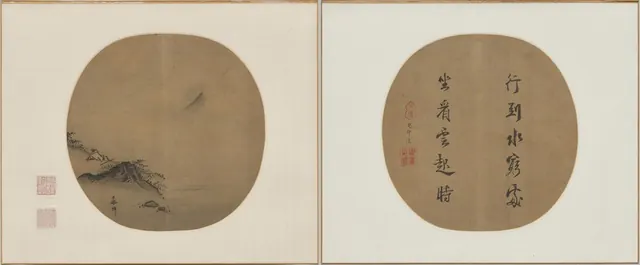
A painter and an emperor responded to the same poetry in two different ways. Lizong transcribed lines by Wang Wei, and the court painter Ma Lin supplied a landscape around 1256. Text and image originally formed a single fan. The poem describes walking to the water’s end and pausing to watch clouds rise. The painter preserves that pause.
A man reclines beside a rock at the water’s edge. His figure is small, but pale clothing helps locate it among dark strokes. His head turns towards open space. The walk continues through looking after the body has stopped. A few lines are enough for Ma Lin to show that change of activity.
The rocky bank gathers in the painted circle’s lower-left corner, leaving most of the surface open. Ma Lin was the son of Ma Yuan, known for concentrating landscapes near one edge. This choice leaves a person facing a space far larger than the patch of ground he occupies.
A mountain barely emerges in the distance. Its dark edge gradually dissolves, making the boundary between slope and cloud uncertain. Diluted ink conveys something changing as it is watched. Prolonged looking need not produce a definitive outline for every part of this landscape.
A few fine lines indicate water beside the bank. They disappear before reaching the distance. The viewer continues the surface across unpainted silk. Reading the poem helps join these sparse marks into a place where someone might pause and wait for clouds to rise.
Calligraphy fills a separate circle at the right. Its columns are denser than the lightly painted landscape. The emperor selected another author’s lines and wrote them in his own hand; the painter then found a figure, bank and distance for them. The object preserves several contributions separated by time and position at court.
Quiet observation of nature became a courtly object that could be held in the hand. The museum connects it with exchanges among the palace, scholar-officials and Chan monasteries around Hangzhou. A wish to withdraw from concerns existed within power itself. The fan could briefly redirect the emperor and his circle towards someone who commands nothing and watches clouds.
- Medium
- Album leaf; ink on silk
- Collection
- Cleveland Museum of Art
- Dimensions
- Image, 25.1 × 25.3 cm
- Accession number
- 1961.421
Sources
Image provided under CC0. Image licence