Green Tara
Attributed to Aniko · c. 1260s, mounted 2020
Explore the painting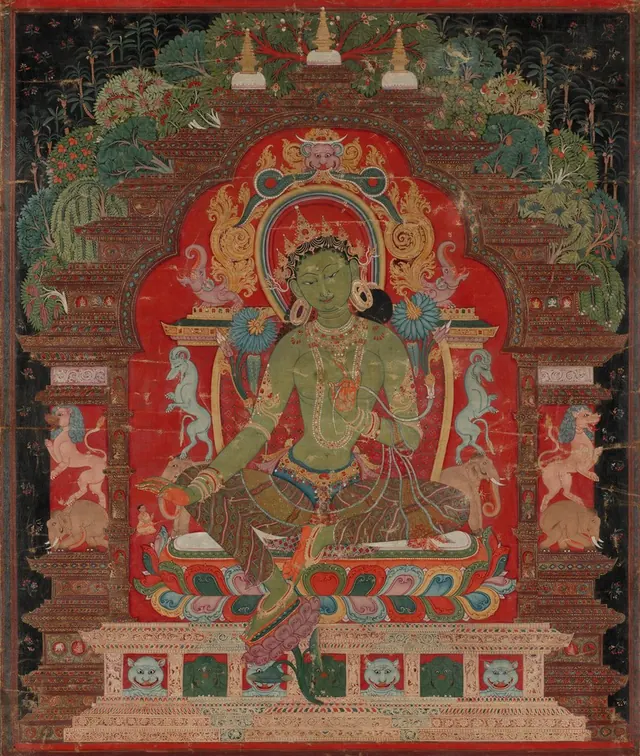
A small monk sits beneath Tara’s extended hand, enormous by comparison. He commissioned this thangka, a Buddhist image on cloth. Made in central Tibet around the 1260s, it is attributed to the Nepalese master Aniko. Green Tara is venerated as a dispeller of fear. The figures’ relative scale immediately explains the image’s purpose: a person seeks protection from an enlightened being whose assistance exceeds his own powers.
Tara’s face inclines slightly, her eyes lowered. Fine lines distinguish brows, eyelids and lips, while green skin stands apart from red. Crown and jewellery confer regal dignity. Yet the inclined head and gentle bodily turn direct that grandeur towards the worshipper. The elaborate decorative setting gathers around a tranquil face.
Her right hand extends downwards with its palm open. The patron in monastic dress sits beneath it. His figure preserves a personal address within the great sacred image. The gesture connects incommensurate scales, from Tara’s richly adorned body to the small human being. The small figure shows the recipient of the promised protection.
Her other hand rises near the chest, a blue lotus stem passing through the fingers. The flower opens beside her shoulder, continuing the hand’s flowing movement. Gestures in Buddhist art communicate teachings and qualities of enlightenment. Colour, fingers and lotus act together here. Worshippers could recognise them in prayer, as they recognised Tara’s name and the mantra addressed to her.
An elaborate shrine rises above Tara, surrounded by trees. A small niche at the top contains the Buddha of the North, associated with her green colour. Tiny figures are incorporated into the architecture, preserving the main figure’s visual priority. Roofs, cornices and foliage make the sacred setting abundant, while the hierarchy of sizes keeps it organised around one recipient of prayer.
Lion and elephant heads alternate along the throne base. This feature connects the work with Tibetan images drawing on north Indian models. Tara’s proportions and some architectural forms stand closer to Nepalese traditions. Researchers compare such details when debating authorship. The painting preserves an encounter of artistic knowledge travelling across the Himalayas with makers, manuscripts and religious commissions.
A mantra associated with protection and freedom from fear is written on the reverse. One side addresses the eye; the other preserves words incorporating the cloth into religious practice. In a museum, a viewer may first notice the beauty of the front and the name of its proposed maker. The mantra records a purpose concerned with the appeal’s efficacy. These ways of valuing the object intersect while assigning it different roles: artistic achievement and participant in prayer.
- Medium
- thangka; gum tempera, ink, and gold on sized cotton; mount: silk
- Collection
- Cleveland Museum of Art
- Dimensions
- Painting, 52.4 × 43.2 cm
- Accession number
- 1970.156
Sources
Image provided under CC0. Image licence