Funerary Panel of a Man
Unidentified painters of Roman Egypt · c. 138–192 CE
Explore the painting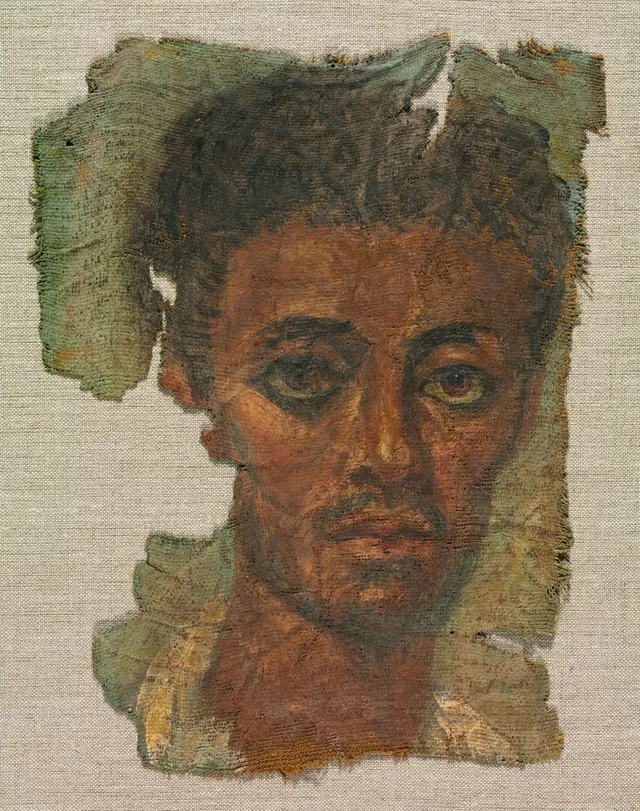
A young man’s face survives on a small scrap of linen. Painted in Roman Egypt in the second century CE, around 138–192, it belonged to the funerary covering of a mummy. Such images were placed over the deceased’s face. Painting that conveyed the head’s volume and individual features joined Egyptian concerns for existence after death. Today’s museum fragment once formed part of a much larger object associated with a particular human body.
Short curls form a dense cap of hair. Along the edges, dark strokes separate into individual locks and overlap the light forehead. The artist worked with wax-based paint. On thin cloth it was applied by brush, whereas a sturdy wooden support also allowed flat metal tools. The support shaped the painter’s movements and the marks that survive.
Brown eyes look straight ahead. Light passages beside the nose and beneath the lower eyelids make the gaze particularly clear. Formal frontality helped the image remain legible on the funerary covering. At the same time, soft transitions between light and shade suggest a rounded head. Ritual stillness meets close observation of a human face.
A few short strokes indicate a slight moustache. The lips are closed, with a highlight on the lower one. Small distinctions separate the face from a generalized mask. They give viewers a sense of encountering an individual, although his name and occupation are lost. The portrait preserves bodily particulars far better than biography.
At the left, the greenish background ends beside a large loss. Threads of the support show around the edges. Linen was less common than wood for such portraits; the fabric itself recalls painting’s proximity to funerary wrapping. The broken edge changes our encounter with the face. It seems strikingly present on material that has barely preserved it into our time.
The neck extends towards the torn lower edge. The rest of the funerary covering is lost. The museum compares its original arrangement with coverings that combined a portrait and Egyptian religious imagery. In that setting, an identifiable face entered an account of the deceased’s passage into another world. The surrounding story has now disappeared, leaving the face as an independent artwork.
After Roman conquest, Egypt retained its funerary customs while adopting new forms of dress and representation. This portrait shows how closely they could meet within one family’s life. Separating the face from the mummy strengthens its familiar resemblance to European portraiture. Thinking again about the linen covering shifts the emphasis: this is also a surviving part of the living’s care for the dead.
- Medium
- encaustic on linen
- Collection
- Cleveland Museum of Art
- Dimensions
- Overall, 24.8 × 19 cm
- Accession number
- 1971.135
Sources
Image provided under CC0. Image licence