Funerary Portrait of a Woman
Unidentified painters of Roman Egypt · c. 138–192 CE
Explore the painting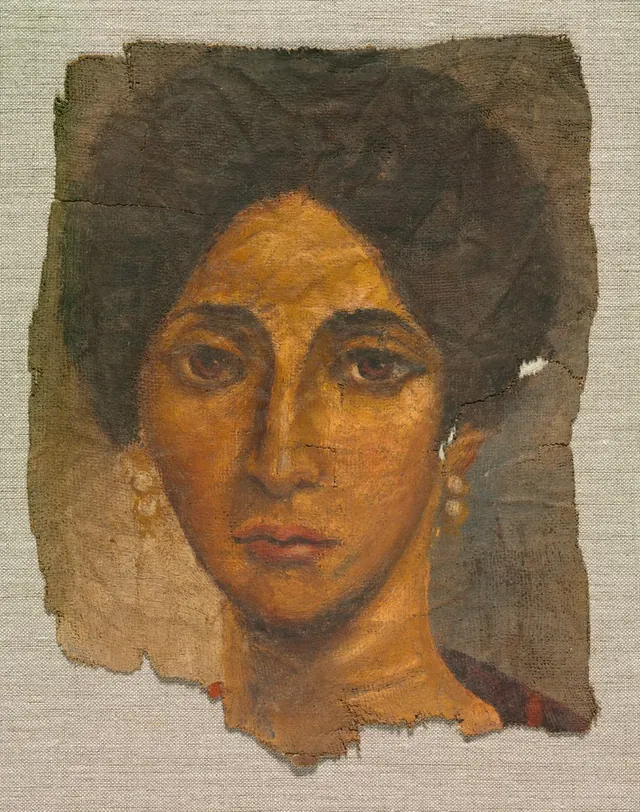
A woman looks towards us from a second-century CE funerary portrait. Painted on linen with wax-based colours in Roman Egypt, it was intended for a mummy’s covering. Face, hairstyle and jewellery preserved a recognizable human appearance within an Egyptian funerary custom. The familiar sense of personal encounter thus comes from an object made for existence after death.
The hair parts above the forehead and gathers into a large dark mass. Its volume greatly enlarges the head’s silhouette. Below, the shape narrows towards the chin, framing the face clearly. Hairstyle belongs to the same presentation of a person as clothing and earrings. The family preserved the deceased’s image with attributes of her earthly appearance.
Thick eyebrows rise above wide-open eyes. Dark pupils and light whites contrast sharply, while ochres and browns model the skin. The artist combined an especially clear gaze with softly rounded facial form. This gives the image presence even on a small surface once surrounded by the rest of the funerary covering.
Light beads are stacked vertically in each earring. They stand out beside the dark hair and repeat the neck’s narrow vertical line. Jewellery indicates the continuing importance of recognizable appearance. Their white highlights belong to the painting; the gold overlays visible on some other funerary portraits are absent here.
Reddish colour survives on the lips. It differs from the cheeks’ warm ochre, while a shadow beneath the lower lip separates it from the chin. A few simple colour relationships suggest living flesh. This persuasiveness served remembrance of the deceased, giving the painter’s skill a significance extending well beyond ornament.
The fabric ends below in irregular projections. The linen weave shows through the paint in places. Its vulnerability is especially apparent beside the confidently constructed face. The object preserves both an effort to retain a person and the damage responsible for memory’s present fragmentary form.
In a museum, such faces readily appear as an early chapter in realistic portraiture. Their original purpose extended beyond preserving likeness. Painting participated in the treatment of a deceased body and a family’s hopes for continued existence. This is both an artistic image of a woman and part of an action undertaken on her behalf. That dual purpose gives the gaze particular force, connecting the painter’s skill with a family’s hopes.
- Medium
- encaustic on linen
- Collection
- Cleveland Museum of Art
- Dimensions
- Overall, 26 × 19 cm
- Accession number
- 1971.136
Sources
Image provided under CC0. Image licence