Prince and ascetics, from the Late Shah Jahan Album
Attributed to Painting by Govardhan · c. 1630
Explore the painting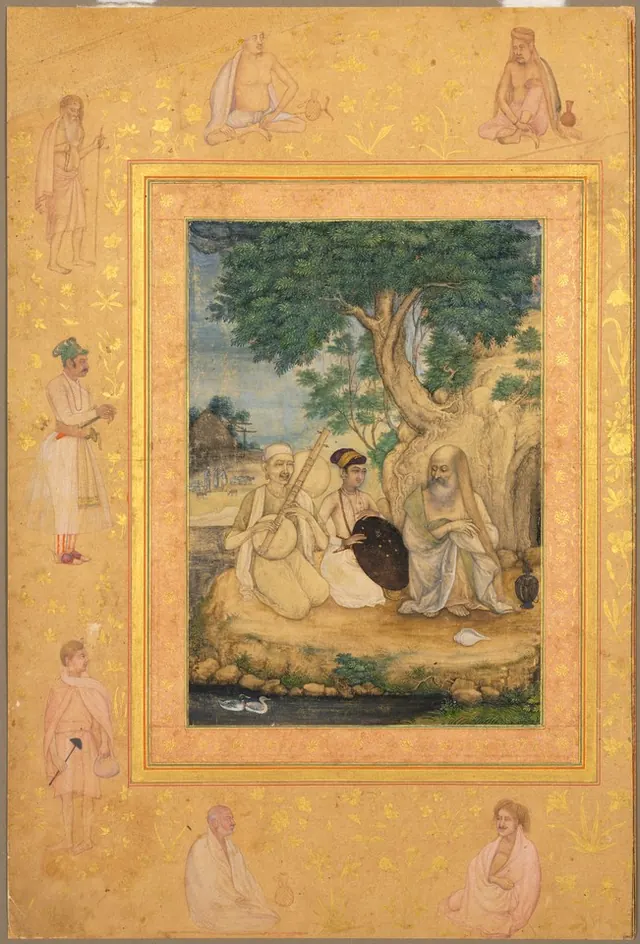
A young prince sits between a musician and a grey-haired ascetic at a cave entrance. The miniature, made around 1630, is attributed to Govardhan, a Mughal court painter. It was later placed in Shah Jahan’s album and given new borders. The prince appears beside a spiritual teacher seated on the ground in simple clothes. An owner of the imperial album could read their meeting as evidence of the ruling family’s piety.
The grey-haired man sits beneath a tree beside a rock wall. In India, a tree’s shade had long been an honoured setting for a teacher. Here the branching trunk rises directly above his head. The museum identifies the ascetic as a Sufi holy man. His dignity appears through simple clothing, a stable pose and his position within the encounter.
The prince sits almost against the ascetic. An elaborate headdress and ornaments distinguish him from his companions, although all sit on the ground. Differences of rank persist while ordinary courtly distance contracts. The painting shows a high-ranking person’s capacity to enter another way of life. At the same time, that proximity gives his authority a spiritual foundation.
At the left, a musician holds a long-necked string instrument. Fingers touch the strings and his mouth is slightly open. In the museum’s account, music relates to Sufi prayer, which could be sung with accompaniment. The encounter therefore includes shared listening. Hand and facial positions make sound imaginable within the group’s overall stillness.
A white conch lies before the ascetic. The museum associates it with a signal marking prayer’s beginning. Its form and colour contrast strongly with the earth and the dark vessel beside the cave. This small object extends events beyond the depicted moment: preparations preceded the meeting, and shared listening had an order of its own.
An elegantly dressed courtier stands in the broad border, surrounded by ascetic figures. The new framing continued the older miniature’s subject. Incorporation into the album strengthened its meaning through the choice of neighbouring images. The margins become an independent part of the narrative, showing which aspect of the earlier painting its new arrangers wished to emphasize.
A pair of ducks swims below; the museum interprets them as harmony between spiritual and temporal realms. Such accord suits an imperial collection. Yet tension remains: renunciation of wealth becomes the subject of a precious object belonging to an extraordinarily wealthy court. The painting accommodates both respect for the ascetic’s independence and power’s wish to associate itself with his authority.
- Medium
- Gum tempera, ink, and gold on paper
- Collection
- Cleveland Museum of Art
- Dimensions
- Image, 20.3 × 14.3 cm
- Accession number
- 1971.79
Sources
Image provided under CC0. Image licence