Alamshah cleaving asunder the chain of the wheel, from volume 11 of a Hamza-nama (Adventures of Hamza)
Unidentified painter of Akbar's workshop · c. 1560s–70s
Explore the painting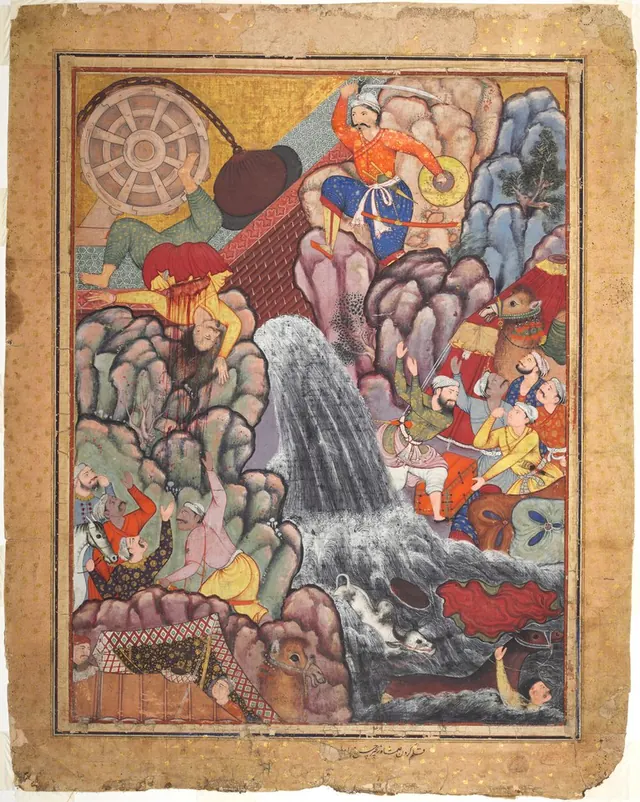
Alamshah raises his sword above a torrent threatening to wash away his father Hamza’s camp. An enemy has opened the dam, and the hero must cut the mechanism’s chain. This episode belongs to the Hamzanama, an immense adventure cycle commissioned by the young emperor Akbar in the sixteenth century. More than eighty centimetres high, the page makes a powerful impression. Action unfolds in several places joined by rushing water.
The hero stands on a rock with a raised sword and small shield. Red clothing separates him from cool stone. His body prepares for a blow intended to change events. Water already rushes beneath him. The picture joins a decisive action with a disaster continuing to develop as the viewer looks downwards.
At the left, an enormous wheel is chained to the dam’s heavy plug. The mechanism explains the flood’s cause and how it might be stopped. A fantastic adventure introduces a tangible problem. Human intervention has made the water dangerous, and rescue requires breaking a particular mechanical part. The feat becomes intelligible without lengthy technical explanation.
The defeated enemy hangs upside down beside the dam, with blood running over the rocks. His inverted body contrasts sharply with Alamshah’s stable stance. The adventure’s violence is explicit. The hero has already overcome one person, yet many others’ fate still depends on what he does next.
People and animals struggle in the torrent below. Closely spaced lines describe water curling around bodies and objects. Accumulated details keep the consequences of events above in view. Within this small part of the page, every object becomes an obstacle and every movement an attempt to survive the shared disaster.
At the right, people in the camp raise heads and hands towards the hero. Their colourful clothes form a dense group beside the water. Attention moves between an exceptional individual and those he must rescue. The narrative suits oral storytelling: viewers could be shown the mechanism, the blow and threatened people in succession.
The Hamzanama was the first great undertaking of Akbar’s painting workshop. Artists of Persian and Indian backgrounds combined different ways of constructing images. Researchers suggest its large sheets were displayed during oral performance. An imperial commission created room for this collective invention. The adventure celebrates a hero’s strength, while the page’s history reveals the organized labour of many painters.
- Medium
- Gum tempera, ink, and gold on cotton and paper
- Collection
- Cleveland Museum of Art
- Dimensions
- Page, 83.7 × 67 cm
- Accession number
- 1976.74
Sources
Image provided under CC0. Image licence