Arhat
Unidentified Korean painters · 1235
Explore the painting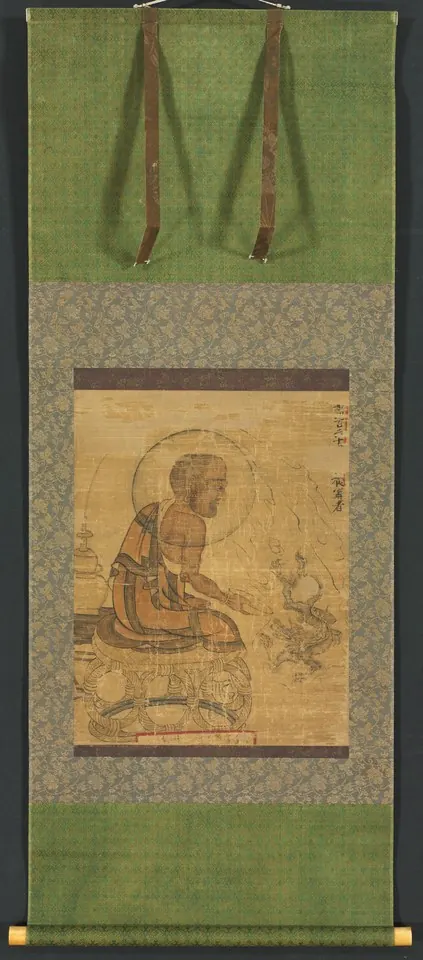
A monk extends a bowl towards a small dragon. This Korean scroll of 1235 belonged to a set depicting five hundred arhats, disciples of the Buddha who attained liberation. An inscription identifies its subject as Segongyangjonja, the 464th in the sequence. An immense spiritual community appears through an individual encounter between a human and an extraordinary creature. Only about ten paintings from the original series are known to survive.
The head appears almost in profile. Fine lines describe a rounded skull, prominent ear and hair gathered behind. A halo surrounds it against the open background. The arhat retains a human body and signs of age. Sanctity becomes a human achievement, even imaginable in someone sitting nearby, despite the miracle before him.
A slender arm extends the bowl. In monastic life, an alms vessel connects renunciation of possessions with dependence on other people’s support. Here the everyday object participates in a miracle: according to the museum, the arhat lures a dragon towards it. Spiritual power appears through modest equipment and a calm gesture.
The dragon coils to the right of the bowl. Its elongated body and delicate whiskers continue into loose, cloudlike lines. Beside the monk’s stable figure, that movement becomes particularly noticeable. A few curves establish two contrasting states: the creature’s active, unpredictable force and the human figure’s composure.
The robe leaves a shoulder bare and falls in long folds towards the seat. Contours lead the eye from the back to the knees and then to the extended arm. Restrained colour lets fine line carry the story. With few objects present, bodily arrangement explains the encounter between monk and dragon in considerable detail.
The seat is constructed from bamboo elements. Curved legs, bindings and horizontal strips receive the same attention as the dragon’s body. Familiar furniture gives the extraordinary event everyday credibility. It also keeps the figure at a human scale. The liberated disciple still sits, wears a robe and holds a bowl.
Within the complete set, five hundred such images made an individual miracle evidence of a great community. The loss of most scrolls now heightens this arhat’s singularity. Yet the inscription’s number preserves the original idea of many beings attaining liberation. The solitary hero of a museum image belongs to a much larger account of human possibility.
- Medium
- Hanging scroll; ink and slight color on silk
- Collection
- Cleveland Museum of Art
- Dimensions
- Image, 52.7 × 40.6 cm
- Accession number
- 1979.71
Sources
Image provided under CC0. Image licence