Tantric Buddha Vairochana as Vajrasattva
Unidentified Tibetan painters · c. 1150–1200
Explore the painting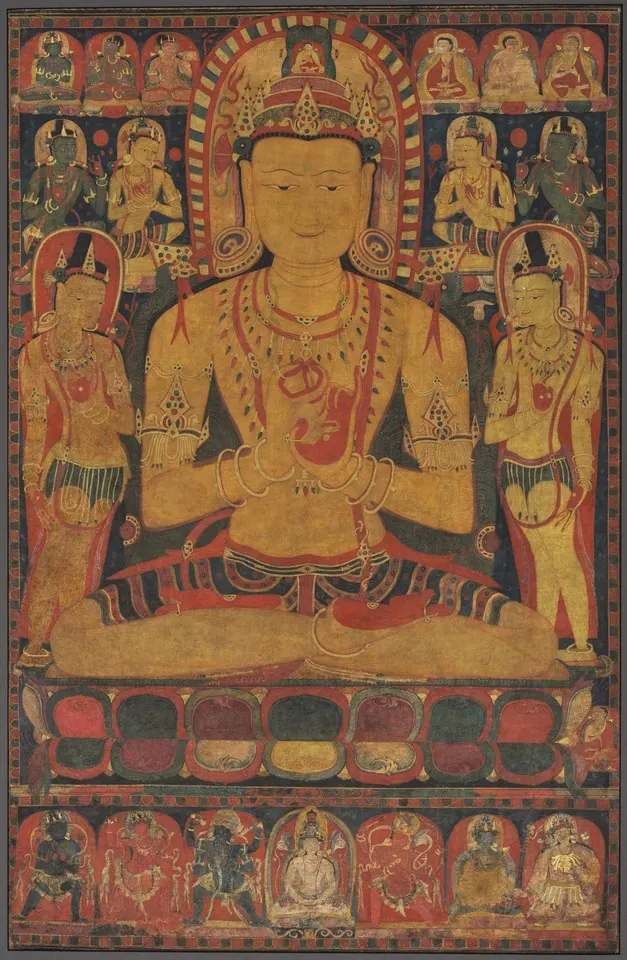
This thangka was made in Central Tibet around 1150–1200. Its great golden figure combines characteristics of two Buddhist forms. The hands identify Vairochana, while the body’s colour and a tiny vajra suggest Vajrasattva, embodying the totality of enlightened beings. Details establish the manifestation of enlightenment addressed before the painting. The patron and his teacher also have places within this sacred gathering.
The golden body occupies almost the full height of the central field. The still seated pose, wide-open eyes and repeated ornaments sustain strict symmetry. Scale immediately distributes attention. Smaller figures form the surrounding assembly, while the viewer first encounters the great face. This arrangement holds a single image together amid the many details necessary for recognition.
One hand clasps the other hand’s index finger. This enlightenment gesture identifies Vairochana. A small six-pronged vajra balances on a fingertip. Easily overlooked, it significantly refines the image’s meaning. In Buddhist painting, a few millimetres can communicate a distinction that a general impression of the figure’s grandeur cannot convey.
A monk appears in the middle of the crown. The museum interprets him as probably the patron’s teacher. A human instructor is placed within an enlightened being’s adornment. This proximity connects knowledge transmitted between people with its sacred source. The painting’s very arrangement gives the teacher’s authority a visible foundation.
Rows of lotus petals form the seat. They surround the crossed legs and complete the symmetrical body below. Their precise repetition continues in ornaments and framing. The viewer encounters an organized space in which every figure has a place. This order distinguishes a sacred assembly from an everyday crowd and joins individual images into one structure.
A small monk-patron sits to the right of the lotus base. His scale is much more modest than the central figure’s, but his presence matters. This large religious painting had a particular occasion and someone who paid for its making. The donation incorporated him into the depicted assembly, leaving a visible record of his connection to teacher and teaching.
Mantras on the reverse invoke the living presence of the depicted beings. The thangka’s meaning therefore arose through painting, words and religious address. Today a detailed museum title tries to distinguish and name the forms combined here. For the patron, their connection had practical significance: it united his teacher, his donation and the hope of enlightenment. The front preserves those relationships, while the reverse recalls the actions through which they became effective.
- Medium
- gum tempera, ink, and gold on cloth
- Collection
- Cleveland Museum of Art
- Dimensions
- Overall, 111 × 73 cm
- Accession number
- 1989.104
Sources
Image provided under CC0. Image licence