Twenty-three Deity Nairatma Mandala
Unidentified Tibetan painters · c. 1375
Explore the painting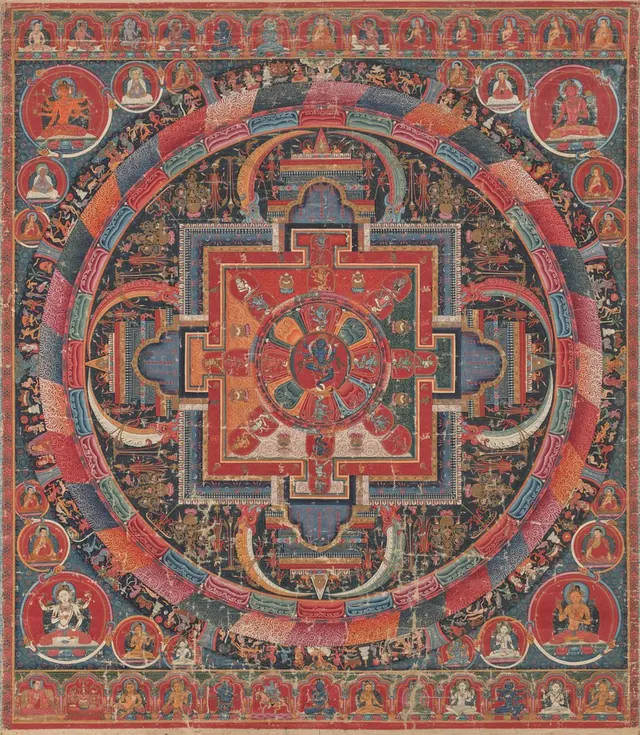
Nairatma dances at the centre of this fourteenth-century Tibetan mandala. A palace with four gateways extends around her, surrounded by cremation grounds. Here “mandala” denotes an ordered realm of enlightened beings. The painting helped an initiated practitioner study and mentally reconstruct that realm under a teacher’s guidance. Geometry organizes movement, while small scenes connect it with the body, fear and death.
The blue figure lifts one leg and holds her arms in an energetic gesture. A red circle sets off the dancing body. Smaller figures around the centre repeat its movement. Strict symmetry accommodates many active poses. The mandala consequently appears both a stable diagram and a place where action unfolds.
The upper gateway appears both as part of a ground plan and as an elaborately adorned façade. This approach reveals the palace’s complete structure. The eye passes through nested boundaries towards the central figure. Architecture establishes a sequence of approach, although the viewer faces a flat cloth covered with paint and gold.
A row of teachers sits along the upper edge. Individual faces and poses occupy matching frames. Particular people transmitted the teaching, and the mandala preserves that continuity. Understanding the image depended on instruction, which gives the teachers a prominent place beside deities and the sacred palace’s architecture.
Small bodies, animals and flames occupy the outer circumference. These are eight cremation grounds. In such places Buddhist practitioners confronted bodily decay and their own fear of death. The painting incorporates those frightening conditions into a path towards liberation. The more closely its beautiful pattern is examined, the more clearly its difficult subject emerges.
In the upper section of the cremation grounds, the museum identifies Virupa, a great Buddhist master. A drink is served beside him; his raised left hand refers to a legend in which he stopped the sun. He also appears in the upper row of teachers. Miraculous narrative and lineage representation reinforce one another, showing different aspects of his authority.
The outer circle and palace hold together things usually kept apart: ordered beauty and bodily disintegration. For a religious viewer, death’s proximity belonged to learning to overcome fear and attachment. For a museum visitor, brilliance and delicate workmanship may initially conceal that purpose. Close looking changes the mandala’s meaning: attractive ornament becomes a carefully arranged encounter with life’s finitude.
- Medium
- Gum tempera, ink, and gold on cloth
- Collection
- Cleveland Museum of Art
- Dimensions
- Overall, 82.5 × 72.4 cm
- Accession number
- 1993.4
Sources
Image provided under CC0. Image licence