Akbar Supervising the Capture of Wild Elephants
Farukh Chela, Govardhan or Dhanraj; attribution debated · c. 1602–3; borders added c. 1700s
Explore the painting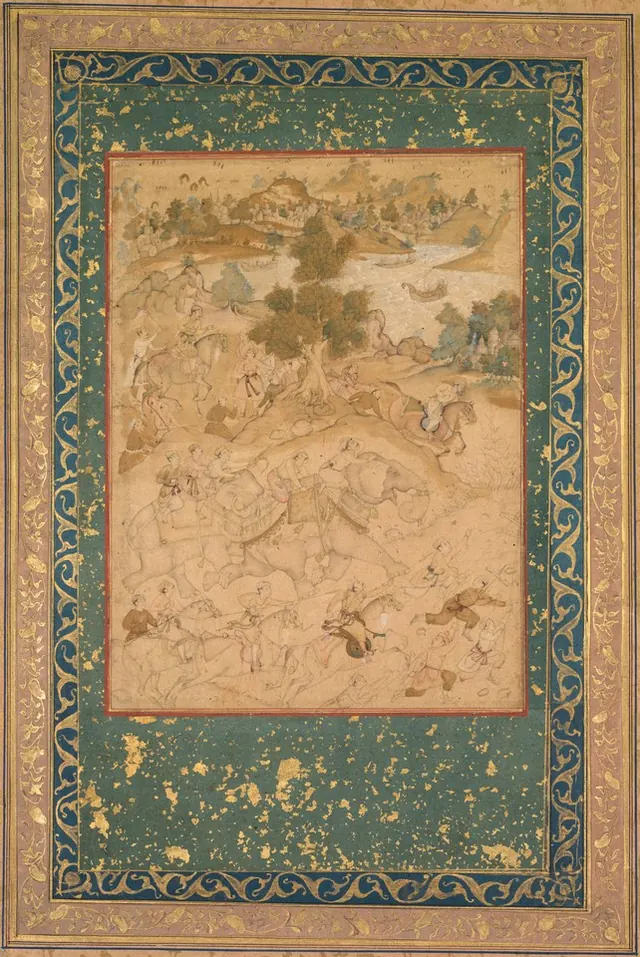
Emperor Akbar watches wild elephants being captured in Malwa. The event took place in 1564, but the illustration was made around 1602–1603 for the Akbarnama, Abu’l-Fazl’s history of his reign. The young ruler is remembered almost forty years later. The court turns a hunting episode into part of a larger account of a ruler’s ability to command people and immense natural forces.
Akbar sits on horseback at the left, above the participants in the pursuit. His figure is small, but his position commands the scene. Authority appears through observation and direction. Dangerous work unfolds before someone whose presence turns it into an event of state.
The two large foreground elephants are trained animals. They help pursue wild ones, combining human planning with the strength of their own species. Drivers sit high on their backs, while the elephants’ bodies fill the passage between slopes. Their size makes visible the difficulty of a task that small human figures undertake collectively.
People run and approach the animals on foot. According to the museum, captured elephants were restrained and accustomed to humans with favourite foods. A lengthy training process lay behind the spectacular moment of pursuit. The illustration condenses that complex practice into gestures and intersecting directions of movement.
Other elephants appear in the distance. They occupy several levels of space, extending the pursuit beyond the principal group. The painter leads the eye upward along a winding route. We can follow a particular danger below while also grasping the scale of the operation.
A town, water and increasingly pale hills form the distance. The museum connects these spatial devices with European prints available at Akbar’s court. Mughal painters adapted imported models for their own histories. The leaf’s authorship remains debated, with Farrukh Chela, Govardhan and Dhanraj proposed. Eighteenth-century borders were later added around the miniature.
Akbar’s glorification here depends on drivers, helpers and the trained animals themselves. They make manageable the strength that the emperor commands. The illustration permits two readings of a reign: an account of an exceptional sovereign and a picture of complex collective work usually concealed behind his name.
- Medium
- ink with use of colors and gold on paper, mounted on an album page with borders of gold-decorated buff and blue paper (recto); calligraphy by Faqir Ali (verso)
- Collection
- Cleveland Museum of Art
- Dimensions
- Page, 37.5 × 25.4 cm
- Accession number
- 2013.309
Sources
Image provided under CC0. Image licence