Stag at Sharkey's
George Wesley Bellows · 1909
Explore the painting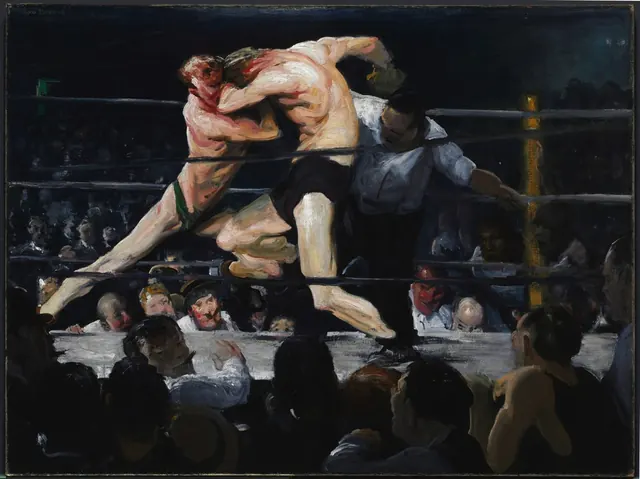
Two boxers grapple in the cramped room of Sharkey’s club in New York. George Bellows painted them in 1909. The club stood near his studio and belonged to former boxer Tom Sharkey. Public bouts were prohibited, so matches took place for private club members. An outside participant received temporary membership and was called a stag, giving the painting its title.
The fighters’ heads and arms almost merge. One pale back obscures part of the other body, while red strokes cross face and shoulder. The painter retains a moment’s compression, when action is difficult to divide into separate blows. Collision is felt before every hand’s position can be resolved.
Legs spread, cross and extend along the ropes. Their diagonals convey the effort of maintaining balance. Bellows himself played baseball and basketball. His interest in bodies appears through a precise sense of exertion: these positions feel temporary, capable of changing in the next instant.
The referee in a pale shirt bends beside the fighters. Bodies and rope partly obscure him. The contest has rules and someone to enforce them, although the painting first communicates the collision’s force. The boundary between permitted sporting action and danger runs through this crowded group.
Spectators’ faces sit almost level with the ring floor. One mouth opens wide while others stretch towards the action. Quick strokes preserve different responses without turning the crowd into detailed portraits. The fight extends beyond two bodies; its spectacle is made by those watching.
Dark foreground heads block the ring’s lower edge. Our viewpoint corresponds to the audience’s places beside the ring. Ropes cross nearly the full width, maintaining the crowded room’s presence. Light concentrates on the fighters’ skin and nearby faces while the remaining interior stays dark.
Contemporaries disagreed about boxing. Some saw courage and healthy strength; others saw cruelty turned into entertainment. By 1909 the sport attracted an increasingly affluent audience. Bellows places the viewer inside that dispute through the position beside the ring. Admiration for skill can coexist with awareness that spectators’ pleasure is paid for in blows received by others.
- Medium
- oil on canvas
- Collection
- Cleveland Museum of Art
- Dimensions
- Unframed, 92 × 122.6 cm
- Accession number
- 1922.1133
Sources
Image provided under CC0. Image licence