Hands at Cueva de las Manos
Unknown artists of Patagonia · About 9,300–1,300 years ago
Explore the painting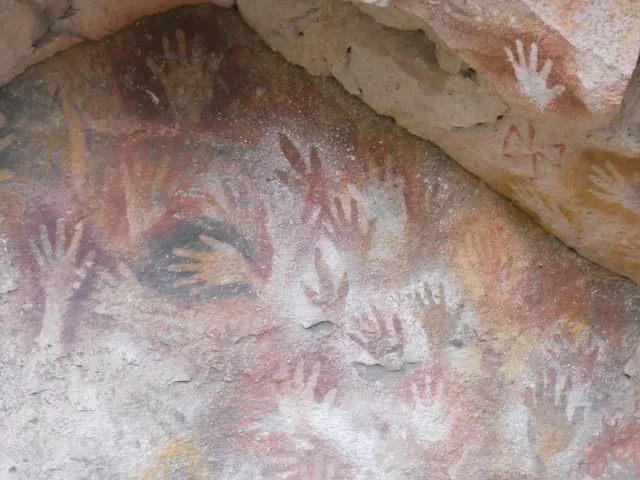
Cueva de las Manos means Cave of the Hands. Its paintings occupy the Río Pinturas canyon in Argentine Patagonia, where people made images over thousands of years. This photograph shows a small part of the complex. Beyond it are hunting scenes, guanacos and geometric signs. The hands belong within a much larger account of human life in this landscape.
Local hunter-gatherers moved as food supplies changed with the seasons. The guanaco, a wild relative of the llama, supplied meat, hides, sinews and bones. Camps occupied places offering water, firewood and shelter. Paintings survive at sites people could revisit during these journeys. The pictured rock remained when its makers moved on.
The large hand on the left points sideways. To make such a silhouette, someone placed a hand against the surface and applied colour around it. Removing the hand revealed the colour beneath. The method transfers the body’s own proportions to rock. Palm width, finger spacing and the position of the thumb become visible without a drawn outline.
The upper hand points upwards. Compared with the sideways palm, both its silhouette and the surrounding gaps change. Different hand positions meet on one surface. Repetition preserves small variations between individual gestures. No standard size or single direction governs every image.
Red, white and dark passages overlap. Iron compounds supplied reds, kaolin white and manganese oxide black. Overlaps help archaeologists establish which image came first. Excavated evidence, including pigments and fallen painted rock fragments, helps refine the chronology. Several layers of colour can thus become a sequence of events.
Hands of different sizes lie close together in the centre. Some are clear; others retain only parts of fingers and edges. From a distance they merge into a dense field of colour, while a closer view separates individual traces. The photograph allows a shift between these two scales — many images together and the shape of a single hand.
Separate traces of pigment remain around some silhouettes. Researchers distinguish two stencil techniques — blowing colour and applying it with a pad. Similar shapes could result from different movements. A hand established the boundary, while application changed the density and texture of the surrounding field. The rock retained the combined effect of body, material and technique.
In 2023 archaeologists Carlos Aschero and Patricia Schneier proposed understanding the complex as a repository of collective memory. They suggest that spoken accounts could preserve who had left a particular hand and at what age. Adding an image would connect someone to an already marked place. Their interpretation draws on repeated returns and relationships between older and newer figures. The spoken accounts themselves have not survived.
Today the continuation of this history depends on the rock’s survival. A dry climate helped pigments last for millennia, but touching, visitor graffiti and removal of fragments damaged paintings. The site entered the World Heritage List in 1999. A photograph records the surface at a particular date. Further research requires both the images and the layers that reveal their history to remain in place.
- Medium
- Mineral pigments on rock
- Collection
- Río Pinturas canyon, Patagonia
Sources
CC BY-SA 3.0. Resized previews and tiles prepared for display; no retouching or upscaling. Image licence