The Dancing Class
Edgar Degas · About 1870
Explore the painting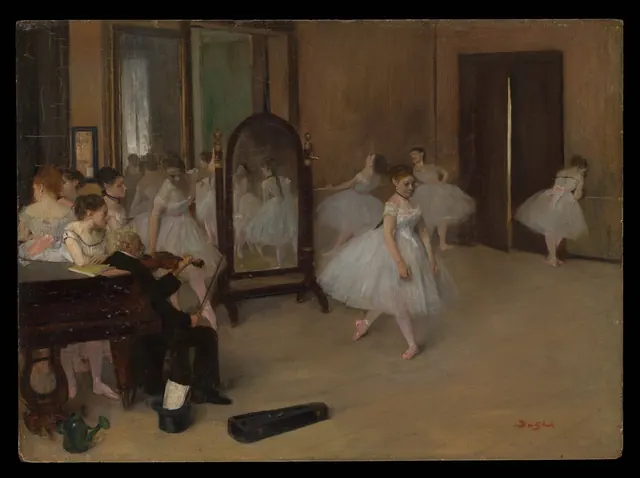
Around 1870 Degas did not yet have access backstage at the Paris Opéra. For his first dance-class painting he staged the scene with dancers posing in his studio. The convincing rehearsal on this small panel was deliberately constructed.
One dancer extends a foot into a large area of empty floor. Figures are clustered more tightly on the left. The interval separates her exercise from the other activities in the room.
Legs and pale skirts reappear in the mirror. Its reflection adds another view within the picture. Degas uses it to reveal space otherwise concealed behind the figures.
The violinist on the left wears dark clothes, clearly visible beside the pale tutus. His accompaniment establishes a working class in which dancers practise and wait.
An open instrument case lies near the lower edge, angled across the floorboards. It occupies part of the empty space in front of the dancers, establishing the foreground without another person.
Several dancers stand in different poses near the back wall. Their skirts overlap while gaps remain between their legs. Repeated costumes make it possible to compare the changes of posture within this small group.
A large area on the right is almost empty. It makes the dancing girl’s foot and faint shadows more noticeable. Degas distributes figures unevenly, giving open floor as much structural importance as the crowded wall.
Degas shared the Impressionists’ interest in modern life, yet often composed his scenes carefully in the studio. Viewpoint and intervals between bodies are crucial here. The entire rehearsal fits on a wooden panel less than thirty centimetres wide.
- Medium
- Oil on wood
- Collection
- Metropolitan Museum of Art, New York
- Accession number
- 29.100.184
Sources
CC0 1.0. Resized previews and tiles prepared for display; no retouching or upscaling. Image licence