Annunciation at San Marco
Fra Angelico · About 1440–1450
Explore the painting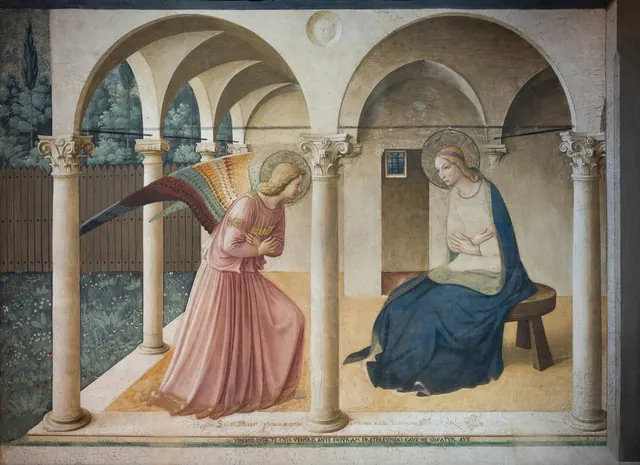
Gabriel tells Mary that she will become the mother of Christ. Fra Angelico painted their meeting on a wall of the residential floor of San Marco in Florence. Its first viewers returned to it during their daily routines. The fresco occupied a shared corridor serving cells and a library. For the religious community, a familiar Gospel episode became a recurring occasion for prayer.
Michelozzo rebuilt San Marco with funding from Cosimo de’ Medici between 1437 and 1443. Angelico, himself a Dominican friar, provided its paintings. The wealth of an influential Florentine, religious life and new Renaissance art came together in this undertaking. Cosimo even had his own cell. The patron maintained a personal connection with the place his money had helped create.
Gabriel has multicoloured wings, each feather individually described. Beside them, his pink robe falls in broad folds, while the walls carry almost no ornament. The difference in detail is immediately visible. His extraordinary plumage identifies a heavenly messenger, yet his body occupies the same illuminated space as Mary’s. The miraculous encounter has a tangible setting.
Mary sits on a simple wooden seat and crosses her arms over her chest. Gabriel inclines towards her with a corresponding gesture. In the Gospel account, her assent opens the story of the Incarnation, God taking human flesh. Here the figures’ answering inclinations convey the exchange. The space between them allows the whole encounter to remain clear, including the movement of each hand.
Columns and arches recede into depth. Their bases, vaults and openings make it possible to imagine where the figures are and how much space lies behind them. Angelico explored new ways of representing volume and perspective. In this fresco they bring sacred history close to the viewer. Mary’s house resembles architecture one could walk around, measure in paces and see in daylight.
A flowering garden is enclosed behind the angel. In Christian readings of the Song of Songs, the enclosed garden became an image of Mary’s virginity. Friars familiar with that tradition could see the fence and flowers as a continuation of her story. The painting connected the space of the house with that of a biblical text. For this reading, a small patch of grass mattered as much as the principal figures.
A small room with a barred window appears behind Mary. It has no sumptuous furnishings; walls, an opening and falling light make up almost the entire view. Against the background of an expensive building project, this simplicity becomes especially striking. Considerable resources created a place where painting invited sustained attention to very few things. Outward austerity could be the result of substantial, carefully organised labour.
Beneath the vaults, the pale surface gradually darkens. Gentle transitions describe the ceiling’s curve, while shadows distinguish one arch from another. The same light picks out Mary’s face and hands. Close observation of the visible world sustains religious concentration here. For Angelico, studying volume and light formed part of making an image before which people would pray.
A Latin inscription runs along the bottom. It asks anyone approaching the Virgin’s image to offer a prayerful greeting before continuing. The fresco thus addresses a person beyond its painted arcade. Mary’s encounter with the angel calls for a response from the passer-by. Through a brief pause and a few spoken words, the image became part of the day’s routine.
Today the fresco can be studied at length in the museum or enlarged on a screen. Its original audience was much narrower, and viewing involved a religious act. Beauty also takes on a different role. It may be a visitor’s main reason for stopping; for a friar living here, it helped renew attention to a familiar story. The same work sustains both kinds of attention, although their purposes differ.
- Medium
- Fresco
- Collection
- Museo di San Marco, Florence
Sources
Public Domain. Resized previews and tiles prepared for display; no retouching or upscaling. Image licence