After the Rain
Arkhip Kuindzhi · 1879
Explore the painting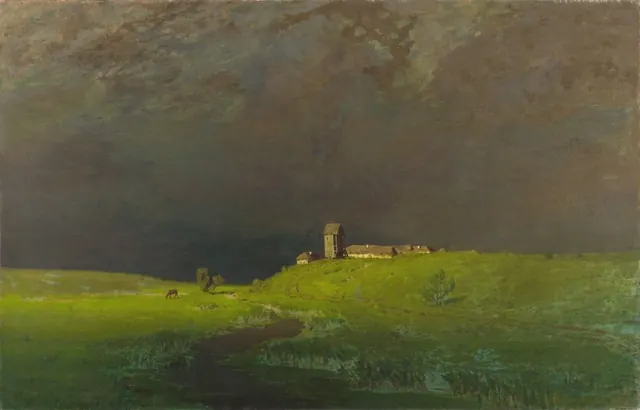
Sunlight has reached the hamlet while an almost black cloud still stands behind it. Kuindzhi painted this change of weather for the 1879 exhibition of the Peredvizhniki, the travelling exhibitors. He also showed Birch Grove and The North. Three different landscapes explored the effects of lighting. Here ordinary paint creates the impression of light far brighter than the canvas surface itself.
Kuindzhi came from a poor family in Mariupol. During the 1870s his landscapes began entering major collections; later he taught at the Academy of Arts, where his students included Nicholas Roerich and Arkady Rylov. His use of broad areas of colour became important to a younger generation of painters. After the Rain already makes that method visible from a distance.
The cloud’s dark underside comes almost directly against the green slope. There is no long transition through many intermediate tones. Beside that darkness the grass appears especially bright. Looking only at an enlarged patch of green weakens part of the effect. Neighbouring areas influence how light each colour appears.
The upper sky works differently. Grey and brownish areas overlap blue, ochre and pinkish passages. Their edges are soft, and the cloud’s thickness changes gradually. Kuindzhi combines the almost abrupt contrast near the ground with closely related tones above it. The cloud retains its volume while occupying most of the canvas.
Light walls and elongated roofs mark the hamlet on the rise. A few small patches distinguish them; windows and the arrangement of the yard are barely legible. This level of detail suits a distant view. The buildings establish an inhabited place without making its people the picture’s protagonists. The principal event remains a change of light across their everyday surroundings.
The horse on the left lowers its head to the grass. Its dark body and thin legs occupy a tiny part of the meadow. The animal’s familiar size helps us judge the space around it. It continues grazing while storm cloud and sunlight divide the landscape into broad areas. This small action gives the extensive view a familiar scale.
The water bends from the lower edge towards the hamlet. Short and long strokes indicate reeds without describing every stem. The foreground, nearest to the viewer, is the most broadly handled area. That difference concentrates attention on the illuminated slope. The museum notes that contemporaries often took Kuindzhi’s handling of such details for carelessness.
This raises a question about a landscape’s truthfulness. One viewer may expect precise descriptions of individual plants. Another may judge the conviction of the overall impression after a shower. Detail is unevenly distributed here. The dispute over apparent carelessness shows how viewers can ask different things of the same landscape and evaluate it on different grounds.
Pavel Tretyakov bought all three exhibited paintings. His notes, studied by researcher Alina Efimova, record a combined price of 6,500 rubles. Kuindzhi’s landscapes enjoyed commercial success while his handling of paint attracted objections. After the Rain belongs both to the observation of a brief change in weather and to a public disagreement over how nature should be painted.
- Medium
- Oil on canvas
- Collection
- State Tretyakov Gallery
- Accession number
- 883
Sources
Reproduction: Wikimedia Commons · Public Domain