The Gulf Stream
Winslow Homer · 1899; reworked by 1906
Explore the painting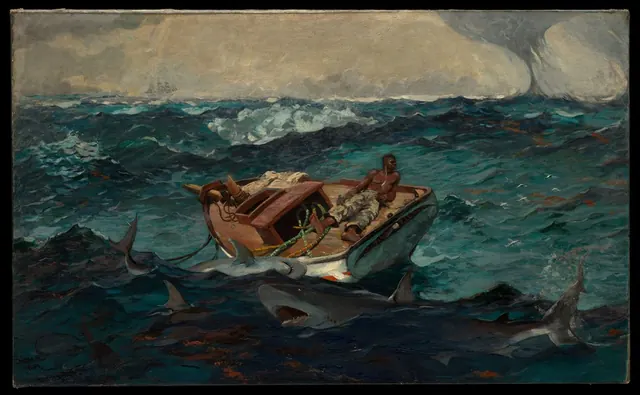
A man remains aboard a damaged boat surrounded by sharks and a waterspout. Sugarcane connects the scene with Caribbean plantation economies. The museum places the current within histories of trade, empire and slavery. Homer continued revising the canvas through 1906.
A man reclines at the damaged boat’s stern. His position reveals limited means of control and escape.
The battered open hull tilts among waves. The vessel no longer provides ordinary protection from the sea.
A large shark crosses the foreground. Danger occupies the space directly between the man and the viewer.
A narrow waterspout descends from a cloud on the right. Another danger remains on the horizon beyond the nearest waves.
A small sailing ship appears far left. It allows the possibility of help, although distance leaves rescue unresolved.
The Gulf Stream belonged to routes carrying people and plantation commodities. Sugarcane connects the maritime emergency with that economy, extending the account of a person facing natural danger.
- Medium
- Oil on canvas
- Collection
- The Metropolitan Museum of Art
- Dimensions
- 71.4 × 124.8 cm
- Accession number
- 06.1234
Sources
Image provided under CC0. Image licence