Prisoners from the Front
Winslow Homer · 1866
Explore the painting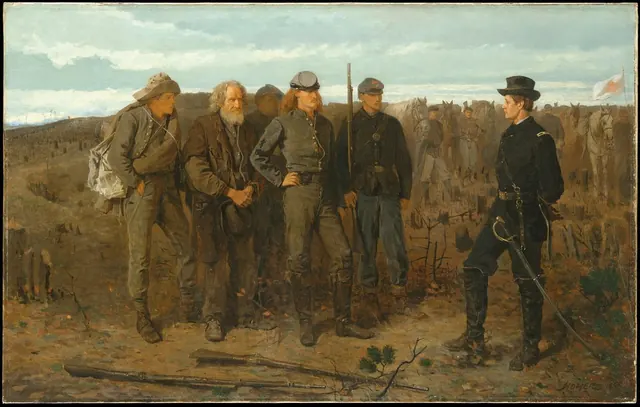
Homer painted the confrontation after the Civil War, drawing on General Francis Barlow’s capture of Confederate soldiers in 1864. Age, clothing and posture differentiate the participants. Damaged ground makes the consequences of war visible beyond the immediate meeting.
A ragged young soldier leans forward. His clothing reveals one prisoner’s material exhaustion.
An older white-bearded man clasps his hands. Age differences recall the variety of people involved in the war.
The long-haired soldier holds a hand at his hip. His confident posture differs from those of nearby prisoners.
A guard stands with a long firearm. Armed presence establishes the meeting’s unequal relationships.
The dark-uniformed officer faces the prisoners from a separate position. The gap emphasises the difference between victor and captives.
Lines of soldiers recede across damaged ground. The nearby encounter belongs to the wider consequences of fighting.
Experience as a war correspondent supplied material Homer revisited after the fighting ended. The painting arranges observations into a postwar consideration of people divided by the conflict.
- Medium
- Oil on canvas
- Collection
- The Metropolitan Museum of Art
- Dimensions
- 61 × 96.5 cm
- Accession number
- 22.207
Sources
Image provided under CC0. Image licence