Sadaksari-Lokeshvara Surrounded by Manifestations and Monks
Unidentified Tibetan painters · late 15th century
Explore the painting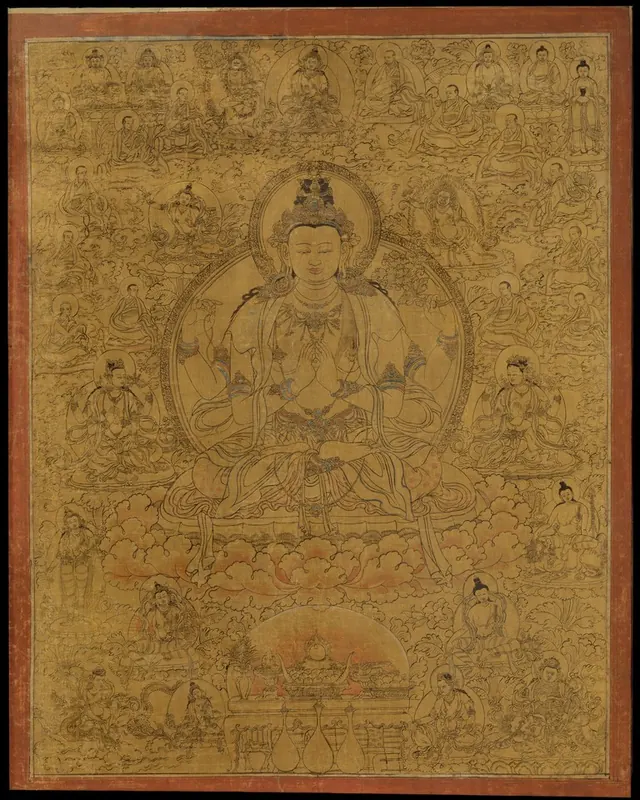
Six syllables of prayer underlie this image. Shadakshari Lokeshvara is a form of Avalokiteshvara, the bodhisattva of compassion, associated with the mantra Om mani padme hum. A late fifteenth-century Tibetan painter surrounded him with deities and monks. The arrangement connects devotion to an image with the teaching and its transmission.
Two hands meet at the chest and another pair rises at the sides. All four belong to the same figure. Their arrangement distinguishes this form of Avalokiteshvara from others. The painting follows established conventions, allowing a viewer familiar with the tradition to identify the deity through posture, gestures, and attributes.
The raised hand on the left holds prayer beads, whose sequence accompanies repeated recitation. The mantra has a specific meaning. In the Fourteenth Dalai Lama’s explanation cited by the museum, mani, the jewel, relates to compassion, while padme, the lotus, relates to wisdom. The final syllable joins wisdom with the method of spiritual practice.
This form of Avalokiteshvara is usually white. Here the face and body are gold, like much of the surrounding field. Fine outlines remain legible against the gold, with small blue and red accents. The artist retained recognizable iconography while changing the figure’s customary color. The museum record does not establish why this choice was made.
Monks in the upper and side rows join the sacred assembly. The museum identifies them as members of a teaching lineage. Human relationships of instruction appear beside the deity. Succession gave a community authority, while the teachers’ images preserved the memory of those through whom the teaching had reached it.
Vessels and offerings occupy the lower section. These small objects are drawn as carefully as the central figure’s ornaments. They recall actions accompanying worship. On a screen we encounter the painting alone, whereas its earlier use could involve recitation, offerings, and a teacher’s instruction. The particular ritual setting of this thangka is unknown.
There is no single principal episode here. Attention can move between Avalokiteshvara, the teachers, gestures, and offerings. Differences in scale establish their positions within the assembly, while the shared gold unites them. A devotional community could encounter its sacred company here; a museum visitor can also consider how that community represented its own tradition.
- Medium
- Distemper, gold and ink on cloth
- Collection
- The Metropolitan Museum of Art
- Dimensions
- Image, 102.6 × 79.4 cm
- Accession number
- 1985.390.3
Sources
Image provided under CC0. Image licence