The Gopis Plead with Krishna to Return Their Clothing: Folio from "Isarda" Bhagavata Purana
Master of the "Isarda" Bhagavata Purana · ca. 1560–65
Explore the painting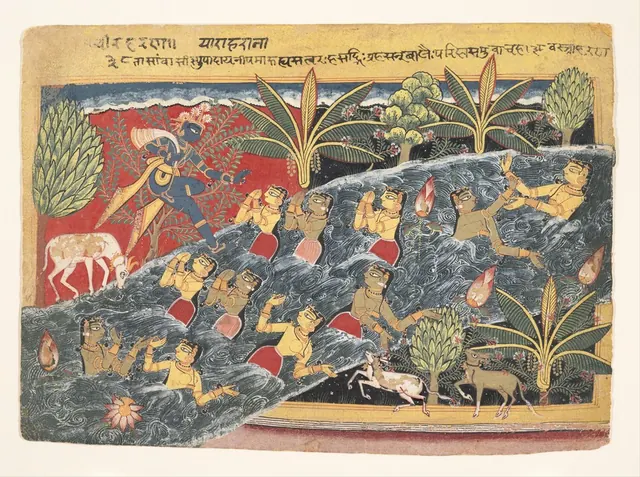
Krishna has taken the bathing cowherd women’s clothing, and they ask for it back. Painted around 1560–65, this folio belongs to the Bhagavata Purana manuscript known as the Isarda series. Its subject belongs to bhakti, personal devotion to a deity. Love for Krishna expresses spiritual aspiration while leaving a visible imbalance between the participants.
Blue-skinned Krishna sits in a tree by the water, clothing draped over his shoulder and one hand extended toward the women. His elevated position makes the action clear: they are in the river and he holds the garments. No elaborate architecture or unrelated crowd obscures the reason for their appeal.
Several women join their palms. The museum reads these gestures as devotion and a desire for union with Krishna. Religious context supports that interpretation beyond the description of an ordinary bath.
At the right, two figures turn toward one another while other women spread or raise their arms. Jewelry and lower garments remain visible. Alternating yellow and grayish bodies distinguish individuals within the dense group, each occupying her own place in the river’s diagonal course.
The river cuts diagonally across the sheet. White curves describe its current, with bodies emerging at different heights. At the lower left, the water crosses the inner frame. This extension continues the setting while preserving each figure’s distinct outline.
Large leaves and animals occupy the banks. The red field behind Krishna and dark land at the right remain flat, crossed by the river’s complex course. Depth is organized through placement and overlap rather than a single vanishing point.
Devotional tradition sees the women’s appeal as a desire for closeness to Krishna. Yet he holds their clothing and decides when to return it. Spiritual meaning coexists with a visible asymmetry of power. The episode will register differently for a viewer beginning with the women’s consent than for a reader who encounters them as embodiments of devotion.
- Medium
- Opaque watercolor and ink on paper
- Collection
- The Metropolitan Museum of Art
- Dimensions
- Image, 18.7 × 25.7 cm
- Accession number
- 1972.260
Sources
Image provided under CC0. Image licence