Mahadevi, the Great Goddess
Unidentified Bikaner painter · ca. 1725
Explore the painting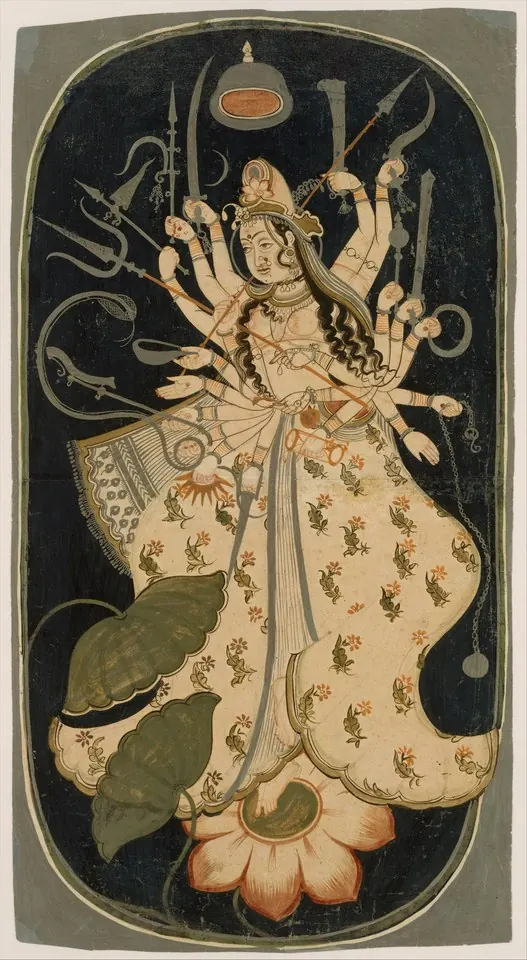
Mahadevi has twenty arms, bearing weapons and attributes associated with different gods, yet they belong to a single Great Goddess. Her devotees regard her as the supreme creative power of the universe. Made around 1725 in Bikaner, the painting also had a courtly significance: the goddess protected the ruling household.
The face and torso remain still at the center of the radiating arms. The small head stands out through its pale color against the dark ground. The goddess is not engaged in a particular battle. The painter gathers her capacities into one image, with numerous implements surrounding a standing figure.
Blades and a trident rise above the shoulder at the left. The museum connects this array of weapons to male gods whose powers are united in Mahadevi. Multiple arms make that union visible. Each implement retains a distinct outline while joining a continuous arrangement around her body.
At the right, the implements continue around an arc. Their complex silhouette remains legible against the nearly black ground. Gaps between the arms keep the weapons from merging into a solid mass. Symmetry is approximate: different curves, lengths, and directions preserve the sense of numerous distinct powers.
A small floral pattern covers the long garment. Weapons and elaborate dress coexist in one figure. The goddess possesses protective and destructive power, presented through the refinement of courtly splendor. Delicate ornament does not diminish the threat of the blades; it lends dignity to the ruling household’s protector.
The feet rest on a lotus. Pale petals separate the figure from the lower edge, while stems and leaves continue the surrounding plant forms. A distinctive support replaces ordinary ground. Together with the multiple arms and isolated background, it places the standing female figure beyond the conventions of a human portrait.
In Bikaner, devotion to the Great Goddess joined dynastic interests. The ruling household sought protection from a female deity whose power exceeded the combined capacities of male gods. A female image’s religious supremacy could sustain men’s earthly authority, while the goddess retained an independent and incomparably greater power.
- Medium
- Ink, opaque watercolor, and silver on paper
- Collection
- The Metropolitan Museum of Art
- Dimensions
- Image, 54.6 × 29.2 cm
- Accession number
- 1996.100.2
Sources
Image provided under CC0. Image licence