Wild geese descending to sandbar
Unidentified Korean painters · late 15th–early 16th century
Explore the painting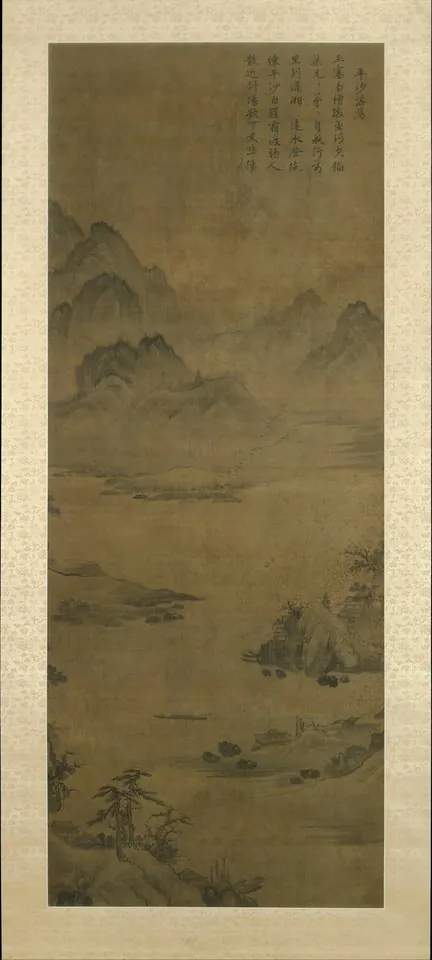
A flock of geese descends over a broad river. This small motif identifies one of the Eight Views of the Xiao and Xiang Rivers. The places are in China, but the scroll was painted by a Korean artist in the late fifteenth or early sixteenth century. It concerns a landscape known through literature and painting, rather than necessarily through the artist’s own travels.
The birds are barely visible dark marks. Their chain crosses the pale water and leads towards a sandbar. Each is smaller than a leaf on a nearby tree. The event that names the painting is therefore discovered only after examining the much larger landscape carefully.
The sandbar is a low elongated strip, separated from water by a few irregular lines. Large areas of silk remain unfilled. Depending on neighbouring forms, they read as river, air, or mist. A single pale field can perform several spatial roles.
Roofs and waterfront buildings appear on the right bank. Their straight lines stand out among the soft mountain contours. The settlements are small and do not dominate the composition. They establish that the valley is inhabited even though people are barely distinguishable in the complete view.
The nearby trees are painted in darker ink. Their branching silhouettes overlap the water, separating the foreground bank from the far shore. As the eye moves up the scroll, contours become softer and paler. Depth emerges from differences in the concentration of the same ink.
Bands of mist separate groups of mountains. Their rounded, sometimes cloudlike forms belong to the manner of An Gyeon, the celebrated fifteenth-century Korean landscape painter. The museum associates this scroll with that manner. Such a relationship identifies an artistic tradition without establishing An Gyeon’s personal authorship.
Calligraphy occupies the upper-right corner. Writing and landscape belonged to a shared field of interest for educated viewers. Classical Chinese subjects gained renewed popularity in early Joseon Korea. A title, a small motif, and a familiar arrangement of space could identify a place for someone who had never visited it.
The view permits two different expectations of landscape. One viewer may seek the riverbanks’ exact geography; another may recognise a poetic theme of migrating birds and an autumn river. The subject’s history supports the latter reading without excluding careful observation of nature. The scroll brings cultural memory together with particular forms of water, mountains, and flight.
- Medium
- Hanging scroll; ink on silk
- Collection
- The Metropolitan Museum of Art
- Dimensions
- Image, 126.4 × 48.9 cm
- Accession number
- 1992.337
Sources
Image provided under CC0. Image licence