The Classic of Filial Piety
Li Gonglin · ca. 1085
Explore the painting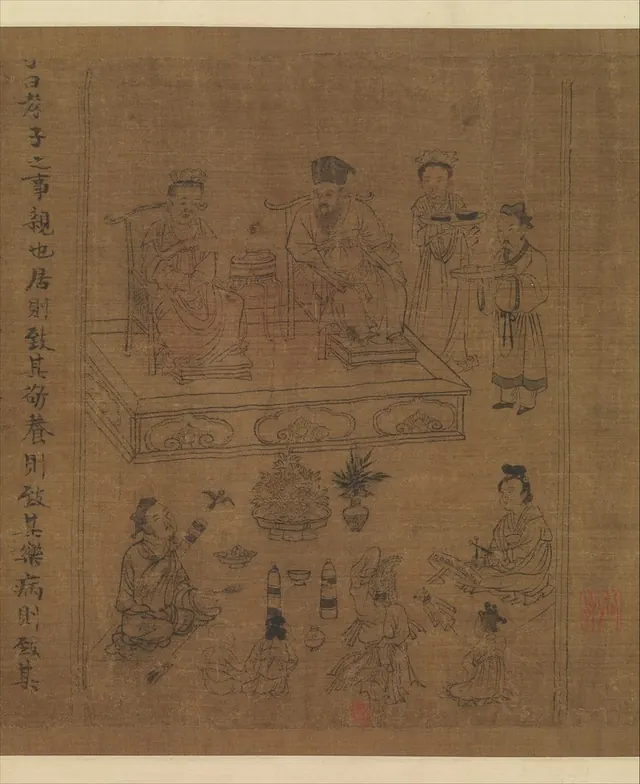
Elders receive food and entertainment. This fragment of Li Gonglin’s scroll, made around 1085, illustrates the Classic of Filial Piety. The ancient text explains how family duties relate to the ordering of society. Under the Song it belonged to the Confucian canon. A scholar-painter turns an ethical rule into a scene of organized domestic life.
A woman sits on a raised platform at the left. Steps and open space before her seat distinguish her position. The older generation occupies the center of household attention. Respect is expressed through the arrangement of places and care before the surrounding text is read.
A man in the second seat also remains still while others act around him. Their different postures establish a social order. Serving elders requires the time and work of younger people. The image presents this dependence as a proper household arrangement to be reproduced.
People approach from the right with offerings and vessels. Each has a task, and the spacing makes their actions legible. Filial respect becomes everyday practice, made up of preparation, service, and attention to another person’s needs.
Participants in household entertainment appear below. Care includes pleasure and diversion for the elders. The scene extends beyond providing food. The painter presents a household whose well-being depends on relationships and on the possibility of spending time together.
Text and image alternate in the scroll. Li Gonglin uses restrained color and line that carries a significance close to calligraphy. This language belongs to his practice as a scholar-painter. References to earlier models connected ethical education to antiquity’s authority.
Li Gonglin used the ancient classic as a measure for his own society. Restrained line and archaic writing support a demand for simplicity and moral responsibility. The ordered domestic well-being in this fragment presupposes duties owed by younger people to elders. Across the whole scroll, such duties also provide grounds for evaluating the behavior of people in high positions.
- Medium
- Handscroll; ink and color on silk
- Collection
- The Metropolitan Museum of Art
- Dimensions
- Overall (a, painting), 21.9 × 475.6 cm
- Accession number
- 1996.479a–c
Sources
Image provided under CC0. A detail of the scroll. The complete work extends beyond this museum reproduction. Image licence