Emperor Xuanzong's flight to Shu
Unidentified Chinese painters · mid-12th century
Explore the painting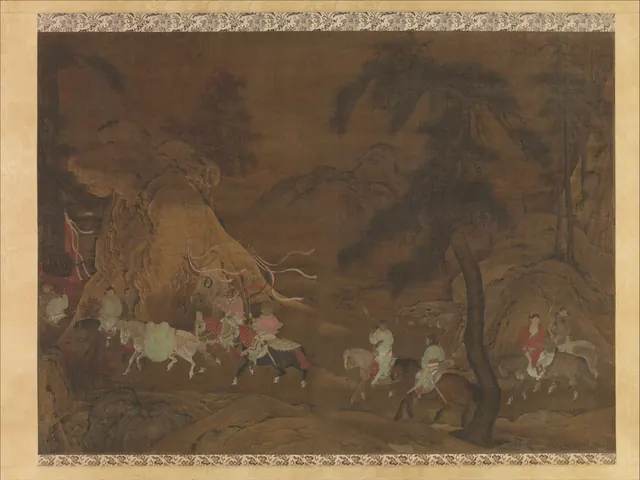
In 755, An Lushan’s rebellion shattered the Tang court’s established order. The following year, in 756, Emperor Xuanzong fled the capital for Sichuan. Along the way, mutinous troops demanded the death of his favored consort, Yang Guifei. She was executed, and the journey continued. This mid-twelfth-century painting revisits the catastrophe several centuries later.
Signs of a court procession appear among the trees. The court travels with its customary ceremonial entourage, although the ruler has lost the capital’s security. Expensive clothing and equipment do not disappear with political defeat. Their presence makes the flight an especially contradictory spectacle.
Riders below turn and travel in a close group. The road gathers people and animals into a narrow band beneath the slopes. Their journey requires coordinated work by the entourage. Even in an image of imperial flight, power depends on those who accompany the ruler, handle horses, and keep the party moving.
A saddled horse without a rider stands out in the foreground. It makes the procession less like a parade of evenly arranged participants. Traveling equipment, bodies turning in different directions, and gaps between figures suggest the duration of the journey. A luxurious entourage must be moved across difficult ground.
Tall rocks and pines occupy much of the space. Equipment and costume evoke the Tang period, while the landscape belongs to twelfth-century painting. History painting joins the event’s past to the artist’s present. The setting becomes the principal means of conveying the refuge’s remoteness and the scale of the journey.
The male courtly entourage continues at the right. Yang Guifei is already absent from this episode. Her death precedes the depicted movement yet changes its meaning. Accounts of the court’s collapse often transferred blame to the favorite. The painting shows the ruler’s entourage continuing after her death.
The elegant procession may initially attract us as a courtly journey. The rebellion’s history turns those same details into traces of lost authority. A tension remains between the painting’s beauty and its violent subject. Those who left the capital remain visible; the woman whose life was sacrificed during their flight survives only in the story’s memory.
- Medium
- Hanging scroll; ink, color, and gold on silk
- Collection
- The Metropolitan Museum of Art
- Dimensions
- Image, 113.7 × 82.9 cm
- Accession number
- 41.138
Sources
Image provided under CC0. Image licence