Wang Xizhi watching geese
Qian Xuan · ca. 1295
Explore the painting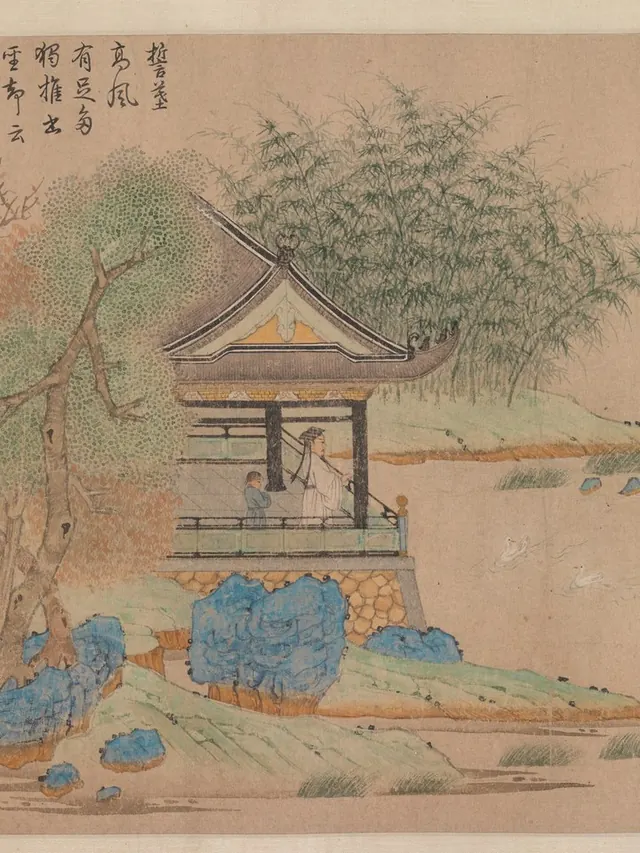
Wang Xizhi watches geese from a waterside pavilion. The celebrated fourth-century calligrapher became the subject of Qian Xuan’s painting around 1295. Behind the nearly thousand-year distance between subject and painter lies another historical transition. After Song Hangzhou fell in 1276, Qian Xuan chose a life outside service to the new Mongol rulers. An earlier master offered a cultural authority independent of the contemporary court.
Wang Xizhi, dressed in pale clothing, stands at the railing. According to tradition, the movement of geese’s necks inspired his handling of the brush. The story connects animal observation with the refined art of writing. Calligraphy demanded long training and control of the hand, yet its inspiration could be found in the natural curve of a living body. The painting presents a pause of observation before possible work.
Two geese swim at the right across pale water. Open surroundings make their small heads and curved necks legible. Qian Xuan does not show a finished piece of calligraphy resulting from this observation. The person stands between birds and art, noticing, remembering, and translating movement into another material.
An attendant in blue stands behind the calligrapher. While Wang Xizhi watches the geese, someone nearby is ready to help him. This small figure qualifies the familiar image of an independent scholar in retreat. Such leisure requires a dwelling and resources, sometimes including another person’s work. Qian Xuan retains this detail beside the story of inspiration.
Blue and green rocks below the pavilion appear as clearly separated forms, recalling an older kind of colored landscape. Qian Xuan deliberately used archaic devices when other methods of rendering depth were available. Painting’s history became a means of choosing cultural affiliations. A landscape could recall an inheritance older than the dynasty that had recently disappeared.
Roof and railings create a delicate geometry within the vegetation. The enlarged pavilion displayed here belongs to a longer handscroll, originally viewed by gradually unrolling it. A viewer moved between landscape and human habitation. That physical process could echo the sustained observation represented by Wang Xizhi.
The ancient calligrapher allows the painter to imagine a life devoted to culture after political defeat. Withdrawal from court does not remove every dependence. Pavilion, attendant, and carefully maintained tradition reveal the resources sustaining that choice. The painting offers honorable retreat together with its organization, in which intellectual activity is supported by material life.
- Medium
- Handscroll; ink, color, and gold on paper
- Collection
- The Metropolitan Museum of Art
- Dimensions
- Image, 23.2 × 92.7 cm
- Accession number
- 1973.120.6
Sources
Image provided under CC0. A detail of the scroll. The complete work extends beyond this museum reproduction. Image licence